
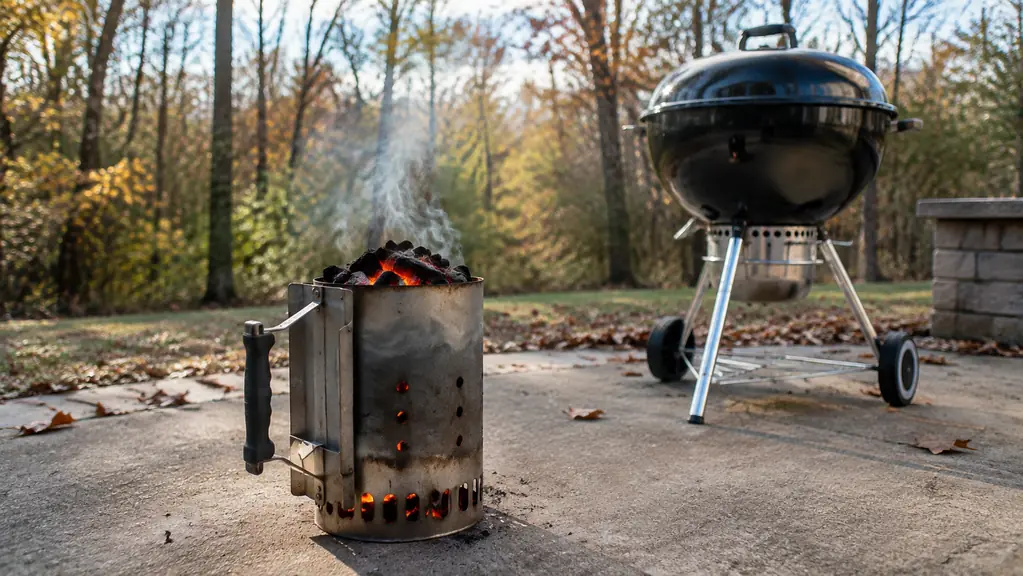
I'll tell you what nobody puts in the listing for the Weber Rapidfire chimney starter. The handle gets warm. Not hot enough to burn you through the heat shield, not if you grab it the way you're supposed to, but warm enough that you notice it when your fingers are stiff from thirty years of machine work. I mention that because it's the one thing I wished somebody had told me before I bought mine, and it's the reason I'm writing this.
I'm Wes. I retired from the tool-and-die trade a few years back and I cook on a 22-inch kettle that's eleven years old, most weekends, for my wife Marlene and whoever shows up. I bought this chimney starter to replace a cheap one that rusted through in two seasons. I've used it for eight seasons of Michigan weather, which means rain, snow, and the occasional July afternoon when the concrete patio could fry an egg. This is what I found.
The Quick Verdict
Does its one job better than anything cheaper I've tried. The handle works for stiff fingers and the coating will age, but not in a way that hurts the food.
Amazon Check Today's Price →A chimney that lights a full load in about eighteen minutes, handle included
I've used this Weber every weekend for eight seasons. It lights lump charcoal evenly, it doesn't leak fluid taste into the food, and the handle works on a cold morning. If you're tired of cheap chimneys that rust, this is the one I'd buy again.
Amazon Check Today's Price on Amazon →How I've Used It
Most chimney reviews are written by people who used one once, on a sunny Saturday, and then put it back in the garage. I've used this one for eight full seasons, and a Michigan year is not a gentle testing ground. It has been rained on, buried under snow in January, left outside in single-digit cold, and baked on a hundred-degree July afternoon. It has lit charcoal for every weekend cook plus a couple of holidays when the whole family showed up. That's somewhere north of four hundred cooks.
What I cook for is six to ten people most weekends, which means I'm not running a full load every time. Half a load of lump charcoal is enough for a dozen burgers on the 22-inch kettle. A full load handles a brisket burn and then some. The chimney doesn't care how much you load it, within reason. It lights what you give it and it lights it evenly, which is the whole point.
The routine is the same every time. I stuff the bottom with crumpled newspaper, fill the top with lump, set it on the concrete, and light the paper through the holes in the base. Eighteen to twenty minutes later the top coals are dusted gray and I tip them into the kettle. That's it. No lighter fluid, no waiting for briquettes to catch, no guessing.
The Saturday before Thanksgiving last year tells you everything. It was 38 degrees, the patio had frost on it, and I had two racks of ribs plus a batch of burgers to cook for nine people. I filled the chimney half full, lit it, and while it worked I went inside to trim the ribs. Eighteen minutes later the top coals were gray and I tipped them into the kettle without thinking about it. That's the test that matters. Not a sunny Saturday in June, but a cold Saturday in November when you just want dinner on the table.
I've also loaned it to the neighbor across the street twice, and both times it came back with a compliment and no complaints. That's the quiet test of a tool. The things that are fussy or fiddly never get borrowed twice. This one did.
The Handle Test
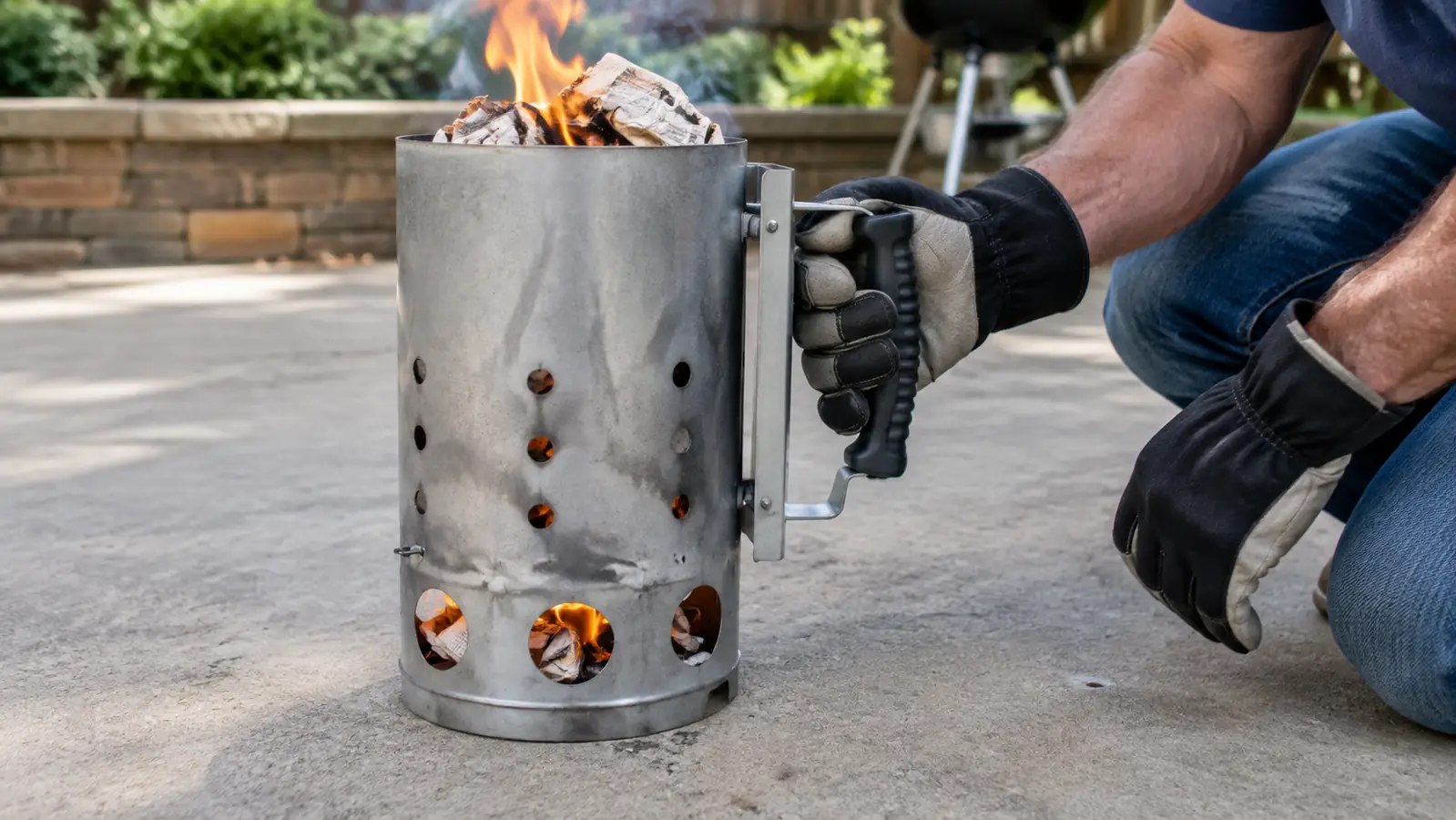
Let me get to the part the listing doesn't tell you, because it's the reason I bought this one over a cheaper chimney. The Weber Rapidfire has a molded plastic handle on the side, with a heat shield underneath. The shield is what makes it different from the old bare-metal loop design. That loop works fine until the chimney is full of hot coals and you have to lift eight pounds of it one-handed. The molded handle gives you something to actually grip.
Here's what nobody tells you. The handle gets warm. Not hot enough to burn, not with the shield in place, but warm. On a cold morning, with my fingers the way they are, I notice it. The fix is simple: I wear a cheap leather work glove on my right hand when I move the chimney. That's a machinist's habit anyway, and it solves the whole problem. I'd rather have a warm handle I can actually grip than a cool metal loop that's slick in the rain.
And the length matters. The handle is positioned so you can lift with your arm mostly straight, not with your wrist bent at an awkward angle. For somebody with stiff fingers, that's the difference between a chimney you use and a chimney you leave in the garage. I lift a full chimney every weekend and I've never come close to dropping it.
I remember one morning in February, single digits, snow on the railings. I had to move the chimney from the paver to the grill and my fingers were already stiff from the cold before I touched it. The molded handle and the glove made it a non-event. With the old metal loop chimney I had, that same move took two hands and a lot of muttered words. This one, one hand, no drama.
The Grate and the Coating
This is the section where I tell you what's going to happen after a couple of seasons, so you're not surprised. The chimney is galvanized steel. Galvanized means a zinc coating over the steel, and zinc burns off when you heat it. The first two or three burns, you'll smell it. That's normal. Do yourself a favor and burn it empty once or twice before you put food anywhere near it. The smell goes away and the coating settles into whatever it's going to be.
After eight seasons of regular use, the coating is gone in patches. There's surface rust starting in a few spots, mostly around the bottom where the heat is highest and where rain pools. Here's the honest part: it doesn't matter. The charcoal never touches the chimney walls in a way that transfers anything to the food, and the rust is cosmetic. I checked the grate and the walls and there's no flaking, no weak spots. The thing is structurally sound.
The bottom grate is the part to watch. It has holes that let ash fall through, and those holes are the only thing between you and a chimney that won't draw. Small chunks of lump charcoal wedge in the holes over time. I clean mine by tapping it upside down on the concrete after it cools, and by running a screwdriver through the holes twice a season. That takes about five minutes. If you never clean it, the airflow dies and your charcoal takes twice as long to light.
The rust showed up around the end of March, after a winter of being rained on and left out. It's surface only. I checked it the way I'd check a part at the shop: scrape it with a fingernail, see if it flakes. It doesn't. The steel underneath the coating is still sound, and the parts that matter, the grate and the base, are holding up fine. I clean the grate holes twice a season, once in the spring and once in the fall, and that's the whole maintenance.
One more thing about the grate. The holes are big enough for ash but not so big that briquettes fall through, which was the failure on my old cheap chimney. That one had a grate that warped in the first summer and let half the load drop into the paper before it caught. The Weber grate has held its shape through eight seasons of heat. That's the difference between a tool built for the job and one built to a price.
What It Does to the Food
The reason to buy any chimney is that it changes the food, and this one does. Lighter fluid leaves a taste that you can't fully burn off, and I say that as a man who used lighter fluid for years because it was what my father used. The first time I cooked over charcoal lit in a chimney, I noticed the difference on the same batch of burgers I'd cooked a hundred times. Clean smoke, no chemical smell, no guesswork about when the coals were ready.
The even lighting matters more than people give it credit for. A chimney lights the charcoal from the bottom up, so by the time the top coals ash over, the whole load is uniformly ready. When I used to light a pile of briquettes with fluid, I'd get hot spots and cold spots and I'd be moving coals around with tongs for ten minutes. With the chimney, I tip the load into the kettle and it's done. The heat is even, which means the cook is even.
I also use less charcoal than I used to. Because the chimney lights a full load reliably, I can load exactly what I need instead of overloading to compensate for coals that might not catch. Half a load for burgers, three quarters for a roast. That's not a huge money thing, but it adds up over a season.
I cooked a whole chicken over a half load of lump last June and it came out the way it should: crisp skin, even color, no gray patches. With the old fluid method I'd get one side done and the other side still pale, and I'd be rotating the bird every few minutes. The chimney took the guesswork out of it. That's the honest reason to buy one, not because it's a fancy gadget, but because it makes the cooking more predictable.
The Tradeoffs Nobody Mentions
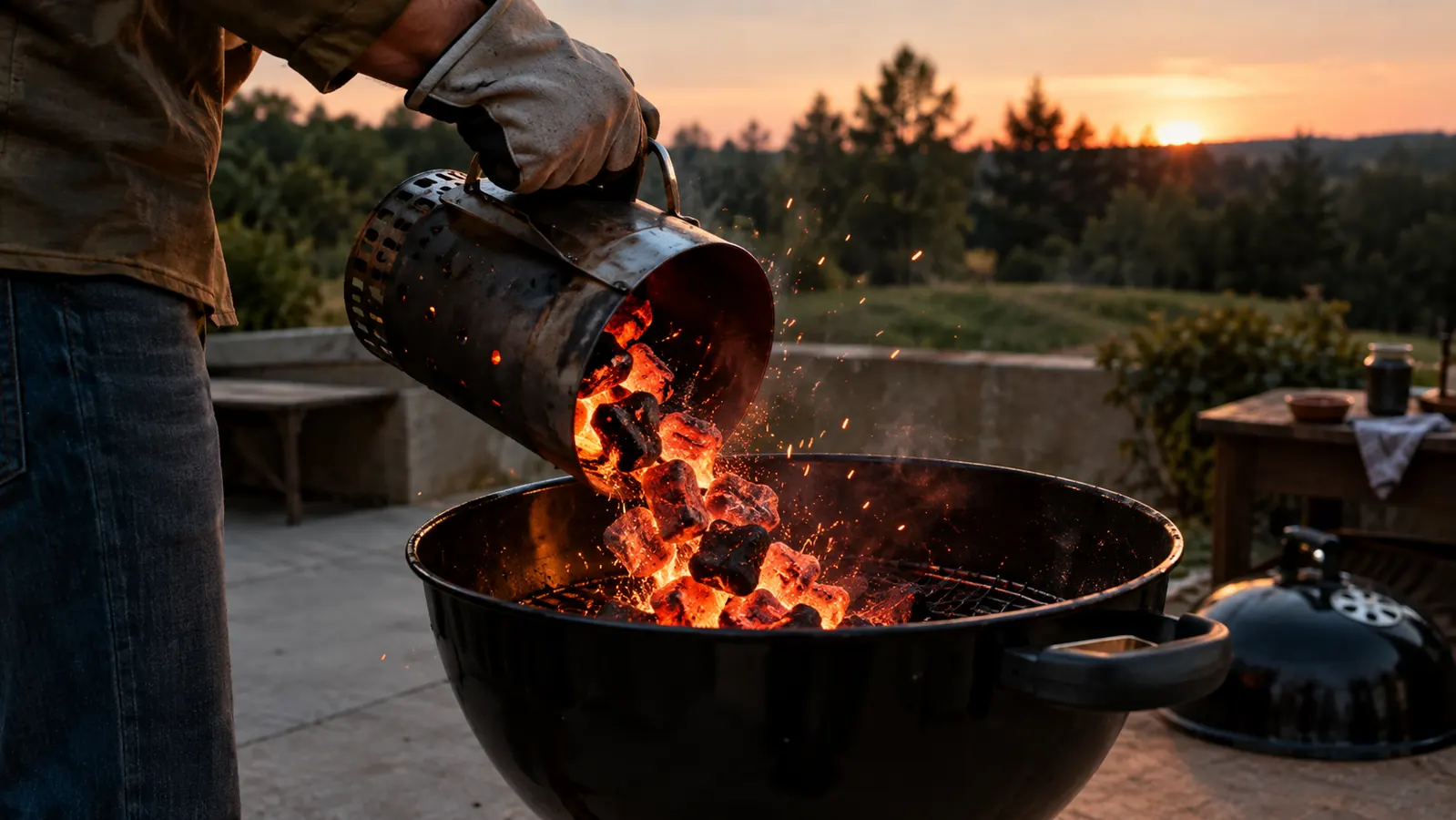
Nothing is perfect, and I'd be lying if I said this Weber was. It's heavy when it's full. A full load of lump weighs somewhere north of eight pounds, and if your hands are anything like mine, you'll want the glove. The wire frame underneath does its job, but I would not set this on a wood deck or on grass. It sits on the concrete, full stop, and I've got a stone paver I move it onto when I'm working at the far end of the patio.
The ash situation is real. Every time I dump the spent coals, a cloud of fine ash goes wherever the wind takes it. On a breezy day, that's into my face. I've learned to dump downwind and to wait until the coals are fully cool, which takes longer than you'd think. This is not a defect in the chimney. It's the nature of burning charcoal outdoors. But nobody puts it in the product photos.
The other tradeoff is that you need newspaper that actually crumples well. I've had mornings when I grabbed a wet section of the local paper and spent ten extra minutes fighting with a chimney that wouldn't light. The fix is to keep a dry stash in the garage, which I now do. That's a user error more than a product flaw, but it's worth knowing.
Cold weather is where this chimney earns its keep. Charcoal in a damp chimney can smolder and stall, and I've seen it happen with the cheap one. The Weber draws air well because the holes in the base are generous and the body is straight-sided, so the draft stays strong even when it's freezing. I lit a full load on a 12-degree morning in January and it was ready in nineteen minutes. That's the test nobody runs in the marketing photos.
What I Liked
- Molded handle with heat shield gives you something to grip, even with stiff fingers
- Lights a full load of lump charcoal in about eighteen minutes, evenly
- No lighter fluid needed, so the food tastes cleaner
- Built better than the cheap chimneys I've owned; eight seasons of Michigan weather haven't bent it
Where It Falls Short
- The handle gets warm after a few minutes, warm enough that I wear a glove
- Galvanized coating burns off in patches and surface rust appears after a season or two
- Heavy when full, around eight pounds, and you'll want a glove for the lift
- Ash goes everywhere on a breezy day and you'll be cleaning the grate holes a couple times a season
Eight seasons of Michigan weather and several hundred cooks later, the worst thing I can say about this Weber is that the handle gets warm and the coating rusts in patches. I'd buy it again.
Who This Is For
This chimney is for the home cook who has already bought the cheap version once and watched it fail. If you grill most weeks, if you've got a kettle or a barrel grill that runs on charcoal, and if you are tired of lighter fluid taste and uneven coals, this is the one. It's also for anybody whose hands are not what they used to be. The molded handle and the heat shield are the difference between a tool you use and a tool you fight. I bought mine after a cheap chimney rusted through in two seasons, and I expect this one to last a good long while.
Who Should Skip It
Skip it if you grill once or twice a year and you already own a chimney that works. There's no reason to upgrade a tool you use a handful of times. Skip it if you're strictly a gas grill person, because you don't need it. And skip it if you expect a chimney that never rusts and never needs maintenance. This is a steel tool that lives outside and gets hot. It will age. If that bothers you, spend more on a stainless version and tell me how it goes. For the rest of us, this one does the job.
The chimney I reach for every weekend
After eight seasons of weekly cooks in real Michigan weather, I'd buy this Weber again tomorrow. It lights charcoal evenly, it doesn't leak fluid taste into the food, and the handle works for stiff fingers. If that's what you're after, check today's price.
Amazon Check Today's Price on Amazon →