
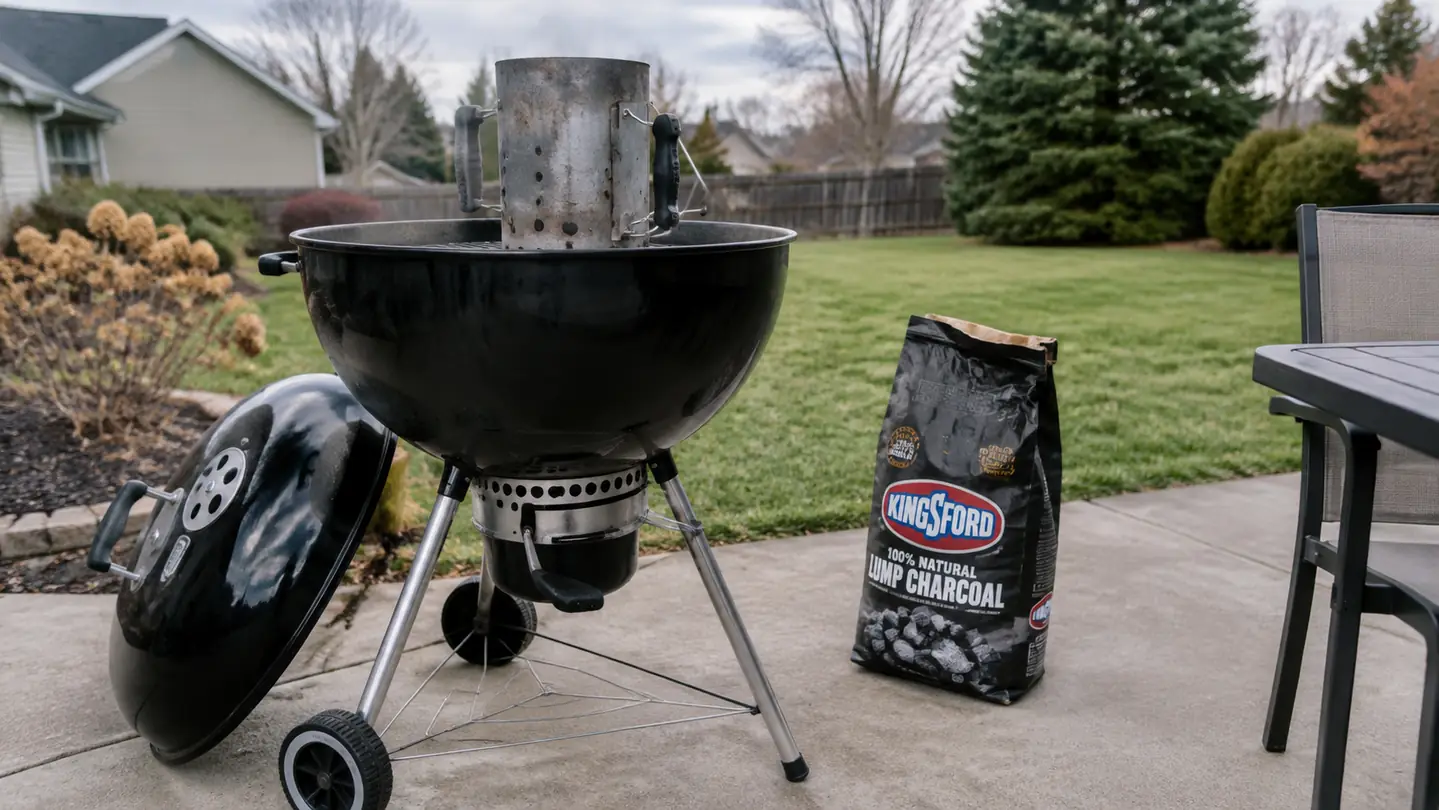
For the first two years I owned my kettle, I lit charcoal the slow way. Stacked briquettes in a pyramid, soaked the middle with lighter fluid, struck a match, and stood back hoping the neighbors did not see the flame. Half the time I got a gray pile of coals with a few hot spots, dumped it anyway, and cooked over uneven heat. The other half I got a chemical taste on the meat that no rub could cover. I bought the Weber Rapidfire chimney starter in year three, and I have used it for eight seasons since. It is the cheapest upgrade I made to that grill, and the one I would not give up.
A chimney starter is a simple machine. A steel cylinder with a grate inside, a handle, and vents around the bottom. You fill the top with charcoal, stuff two sheets of newspaper under the grate, light the paper, and ten to fifteen minutes later you have a chimney full of coals ready to cook over. No fluid, no chemical taste, no standing over a smoking pyramid. The Weber is not the cheapest chimney on the shelf, and it is not the most complicated. What it is, after eight years of Michigan winters and summer cookouts, is the one I would buy again. If you have been telling yourself you will switch off lighter fluid someday, this is the weekend to do it. The first cook with the chimney takes ten extra minutes to set up, and it saves you a standing-over-smoke hour for every cook after that.
The Quick Verdict
Eight seasons in, the Rapidfire is the benchmark chimney starter. It is not perfect. The handle can bite you if you grab it wrong, and there is no lid, but it lights a full chimney of lump in twelve minutes, every time, and it is the one I would buy again.
Amazon Check Today's Price →Skip the lighter fluid this weekend.
The Rapidfire lights a full chimney of lump in about twelve minutes, with no chemical taste and no standing over a smoking pile. It has done it for me for eight seasons. Check today's price on Amazon.
Amazon Check Today's Price on Amazon →How I've Used It
I have owned the Rapidfire for eight seasons. It lives on the concrete patio behind the house, open to everything Michigan throws at it. Snow piles on it in January, rain runs down the sides in April, and in the summer it sits within arm's reach of the kettle. On most weekends I light it at least once, sometimes twice. My normal cook is six to ten people, and for that I run two loads through it: one chimney for the direct side, and a second load that burns down while the first cooks. By the time the burgers come off, the second chimney is ready for the coals I bank on the cool side.
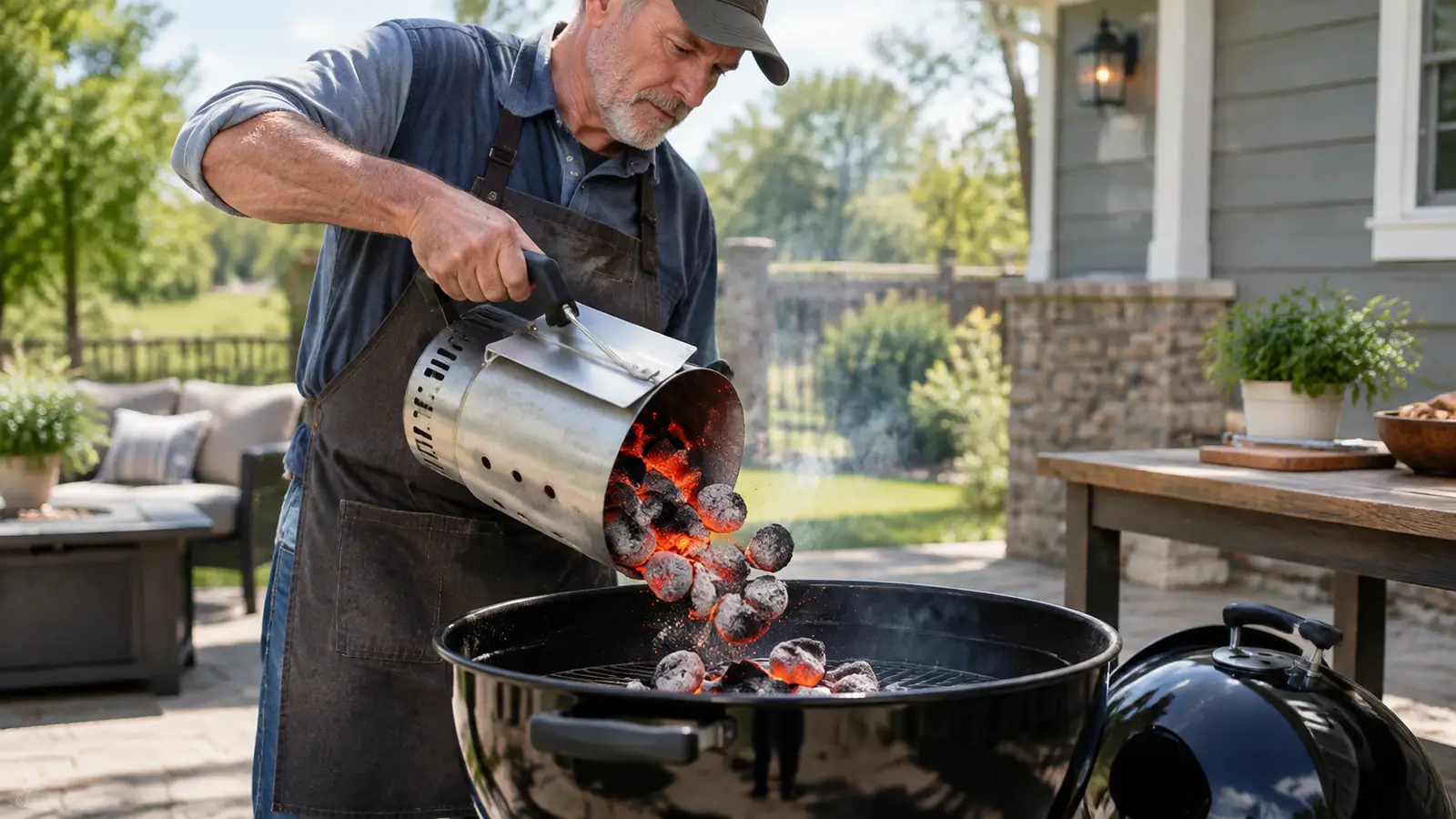
The routine has not changed in eight years. I pull two sheets of newspaper, wad them loosely, and stuff them under the grate from the bottom. I fill the top with lump charcoal, not briquettes. Lump lights faster and burns cleaner, and the wide mouth of the Rapidfire takes a full load without my having to balance pieces on the edge. One match, dropped through a vent hole, and that is it. Ten to fifteen minutes later the top layer of coals is ash-gray, and I pour them into the kettle with one hand.
The stiff fingers matter here. Thirty years of machine work left my hands slow in the cold, and a lot of grill gear assumes you have a younger grip. The Rapidfire handle is long enough that I can carry a full chimney one-handed without my knuckles brushing the hot steel, and it mounts low enough that the weight sits over my palm instead of pulling at my wrist. In January, when I light the kettle off the back porch in three feet of snow, that is the difference between a comfortable cook and a miserable one.
The other thing I notice every cook is what I do not smell. No lighter fluid means no chemical haze hanging over the patio and no taste on the first burger. My wife Marlene noticed it the first summer, and she is not one to comment on grill gear. The chimney changes the cook before the coals even hit the grate.
The Handle
The handle is the part most chimney reviews skip, and it is the part I notice every single cook. It is a flat steel strap, bent at the ends, mounted to the side of the can. It is not insulated, and it is not fancy. But the geometry is right. The bend puts your hand about three inches off the hot metal, and the length is enough that my whole palm fits without crowding. I can pick up a loaded chimney, walk ten feet across the patio, and pour without setting it down.
There is one thing to know, and it is worth saying plainly. The handle can burn you. If you grab it too close to the can, or if your thumb rides up over the mounting tab, you will learn why they tell you to wear a glove. I burned the web of my hand once, reaching past the handle to steady a full chimney. That was my mistake, not the tool's, but it happened. Wear a leather glove and grab the handle by the middle.
How Fast It Really Lights
On a still morning, with dry newspaper and a full load of lump, the Rapidfire gets to a gray coat in about twelve minutes. Fifteen if the air is cold or the lump is damp. That is fast enough that I start the chimney before I walk back in to season the meat, and by the time I have the rub on and the grate cleaned, the coals are ready. The first time I used it, I stood there waiting for it to fail, the way you do with any new tool. It did not fail.
The even heat matters more than the speed. A chimney lights the whole load at once, top to bottom, because the paper fire draws air up through the coals. What you pour out is a chimney full of coals at the same stage, all ash-gray and glowing, instead of the patchwork you get from a fluid-soaked pyramid. On a kettle, that means the direct side is actually hot across its whole surface, and the indirect side stays cool. That changed how the food came out, more than any other piece of gear I own. A clean, even bed of coals is what separates a decent burger from a good one, and it is what makes the indirect side of the kettle actually useful for a rack of chicken.
Lump versus briquettes: lump lights faster and runs hotter, and it is what I use. The chimney handles both. If you use briquettes, figure a few extra minutes and make sure the newspaper is dry. Nothing about this chimney cares which fuel you feed it.
What Eight Michigan Winters Did to It
Durability is where cheap chimneys fail, and it is why I keep recommending the Weber. I owned one cheap chimney before this one. It had a folding handle and a can that warped in its first summer of high heat, and by its second season the vents had rusted through. The Rapidfire has been rained on, snowed on, and baked, and it is still square.
That is not to say it is immortal. The vents at the bottom have rusted, and I expect they will keep rusting. The steel is painted, not stainless, and the paint will wear at the edges eventually. Mine has a ring of rust around the vent band and a patch on the bottom where it sits on wet concrete. None of it affects how it lights. I wire-brush the vents twice a season, and the thing keeps going. Eight years in, that is an honest answer to the question of whether it lasts.
The one weather note is the lid, or the lack of one. If you leave the chimney out in the rain, it fills with water, and you will pour a wet load onto your grill. I keep a sheet of steel over the top when I know a storm is coming, or I lean it against the side of the house. A lid would have been a small addition, and its absence is my one real complaint about the design.
The Two Things I'd Change
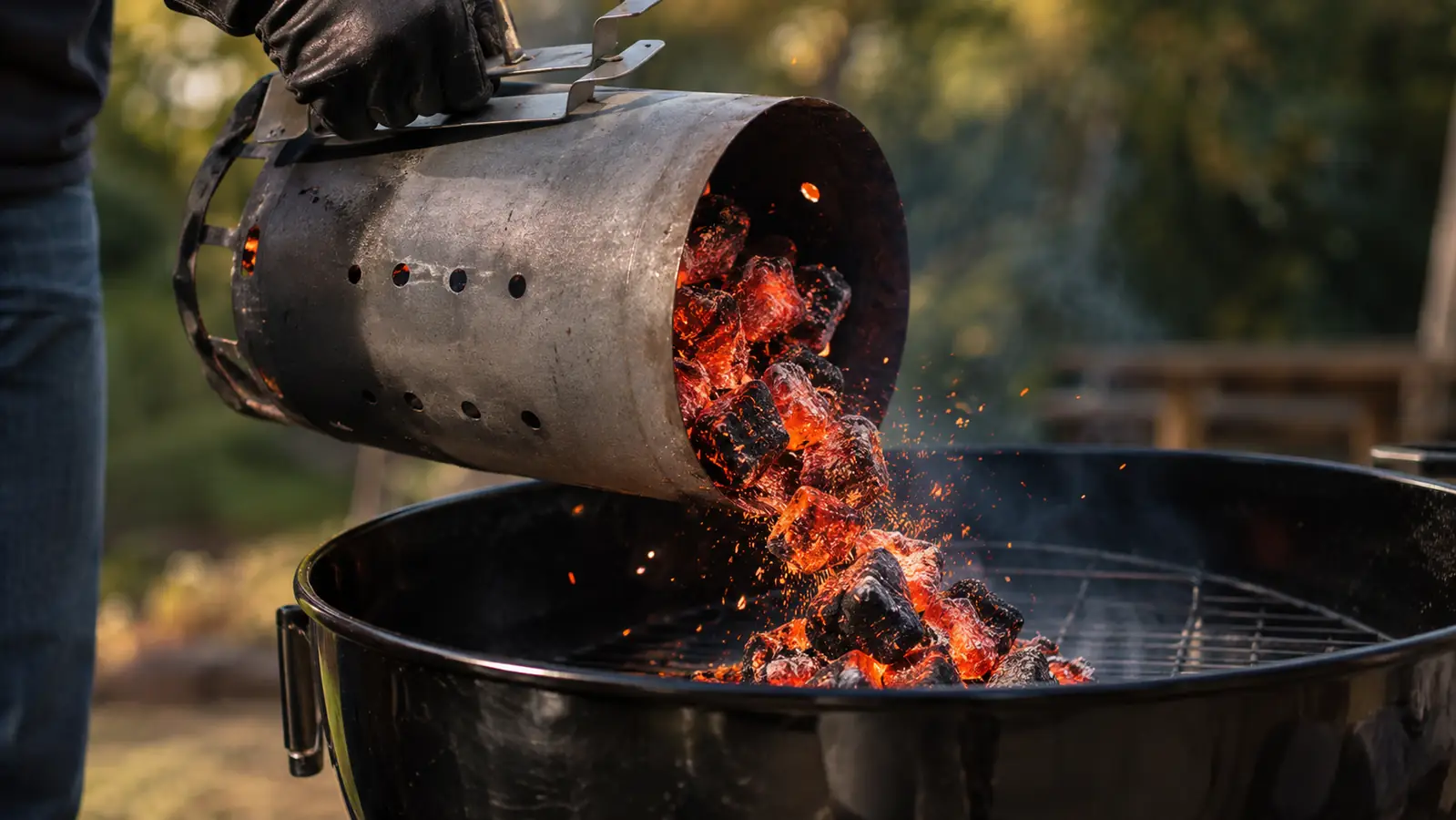
The missing lid is the first thing I would change. The second is the pour. The Rapidfire mouth is wide, which makes filling easy, but it pours a little wide too. You get a few stray coals on the grate when you dump, nothing that ruins a cook, but a chimney with a tighter spout empties more cleanly. I have never found that a reason to switch. The trade-off is fair: a wide mouth fills fast and empties fine.
The third thing, if I am being thorough, is that the handle gets warm if the chimney sits too long after the coals are ready. Steel conducts heat, and after fifteen minutes of sitting full, the handle is warm enough that I use the glove I already have on. It is not a flaw so much as a fact of the material.
I looked at the alternatives before I settled on this one, and I still look at them on the days the handle reminds me it is warm. There are cheaper chimneys that work, and there are fancy ones with folding handles, insulated grips, and stainless bodies. The stainless ones cost three times as much and weigh twice as much, and for a chimney that lives outdoors in the weather, I would rather pay less and take care of the rust with a wire brush. There are electric starters too, and they work fine if you have an outlet on the patio. I do not, and I do not want a cord running across the walk. For my patio, a chimney is the answer, and the Rapidfire is the chimney I keep coming back to.
The Bottom Line
Eight years is a long time to vouch for a piece of grill gear, and the Weber Rapidfire has earned it. It lights lump charcoal fast and even, it survives the weather, and the handle works for a man with stiff fingers. It has two small faults, the missing lid and the wide pour, and neither has ever made me wish I had bought something else. If you cook on a kettle and you have been putting off the switch away from lighter fluid, this is the tool to break the habit with. I waited two years to buy one, and those two years are the only part of the decision I regret.
What I Liked
- Lights lump charcoal in twelve to fifteen minutes with no lighter fluid
- Heavy-gauge steel that has survived eight Michigan winters
- Wide mouth takes a full chimney of lump without balancing pieces
- Handle is long enough to carry and pour one-handed
- No chemical taste on the food, ever
Where It Falls Short
- The handle can burn you if you grab it wrong or reach past it
- No lid, so rain and snow collect in the top if you leave it out
- Vents rust eventually no matter what you do
- Pours a little wide, so a few coals land on the grate
Twelve minutes from a cold start to a chimney full of gray coals, and it has done it every weekend for eight years. That is the whole review.
Who This Is For
Buy the Rapidfire if you cook on a kettle or a drum grill most weeks and you are tired of lighter fluid, or of standing over a pyramid with a match. Buy it if you have already bought one cheap chimney and watched it warp or rust, because this is the one that does not. Buy it if you cook for company, because a full chimney lights fast enough that you can start it and still have time to season a rack of ribs before the coals are ready. And buy it if you want the same tool every time, because eight seasons in, mine still behaves exactly the way it did on day one.
Who Should Skip It
Skip it if you cook on gas and only light charcoal a couple of times a year, because a basic hardware store chimney will get you through that. Skip it if you need a full charcoal grill lit in three minutes flat, because no chimney does that, and an electric starter or a propane torch is the tool for that job. And skip it if you expect it to look new forever. It is painted steel that lives outdoors, and it will show its age. That is the honest trade for a tool that costs what this one costs and lasts as long as this one lasts.
Eight seasons and counting.
The Rapidfire is the one chimney I would buy again, and nothing in eight years has changed my mind. Check today's price on Amazon.
Amazon Check Today's Price on Amazon →