
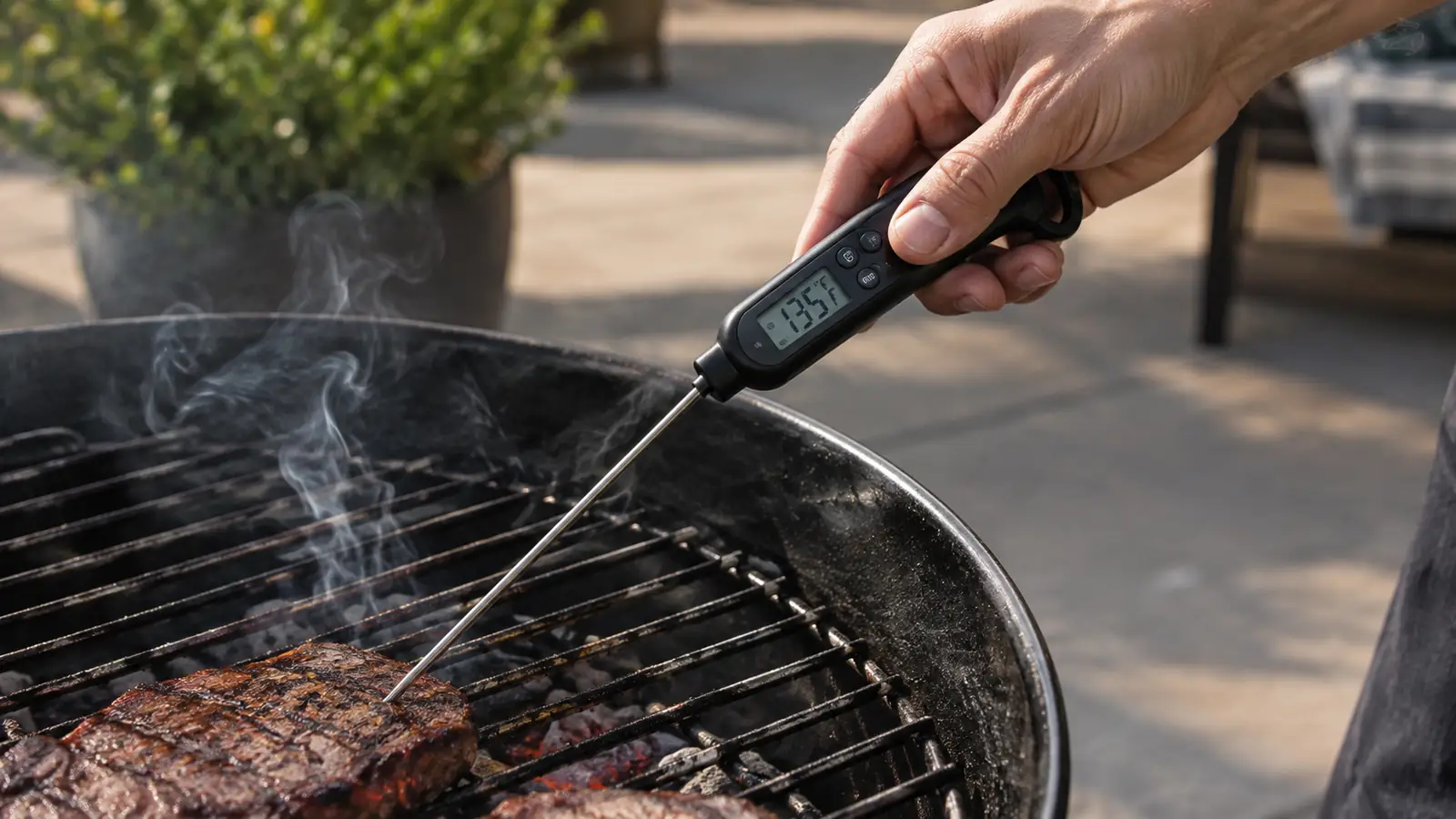
It took me forty years of cooking to stop guessing. I have a 22-inch charcoal kettle that has been on my patio for eleven years, a three-burner gas grill for weeknights, and a pellet smoker I bought used four years back. Through most of that time I checked doneness the old way, with a knife slit and a finger. The knife slit works fine for a steak you are eating that night. It does nothing for a pork shoulder you have had on since six in the morning.
Two springs ago I finally bought a TempPro TempSwift, the digital instant-read thermometer with the four-inch folding probe. I have used it nearly every cook since, through a Michigan summer that hit the mid-nineties, through rain that came down sideways, and into the first freeze of November. This is what two seasons of daily use actually looks like.
The Quick Verdict
A fast, accurate instant-read thermometer that took two full Michigan seasons of rain, frost and drops without a complaint. At its price, it is the thermometer I hand to a neighbor who wants to stop guessing.
Amazon Check Today's Price →The thermometer that ended my guessing
After two seasons on the patio, the TempPro TempSwift is the tool I reach for on every cook. It reads in two seconds, reads true, and has not flinched at rain, frost or a drop on concrete.
Amazon Check Today's Price on Amazon →How I've Used It
It is late May when the thermometer first went to work. I had a pork butt on the kettle, lump charcoal, running about 250 degrees, and the plan was to have it done by supper for six people. With the old knife method I would have waited until I could not stand it anymore, cut a slit in the meat, and hoped the color looked right. Instead I used the TempPro every hour on the hour. At three in the afternoon it read 168. At four it read 172. At five it read 174, and I pulled it, wrapped it in foil, and let it rest for an hour. It came apart with a spoon. Nobody at that table needed a knife, and I have not gone back to slitting meat since.
The stall taught me more than any single cook. In July I had a brisket flat that climbed to 162 and then sat there for fifty minutes. My old habit said wrap it, push through, get dinner on the table. The thermometer said the meat was fine, the connective tissue was still rendering, and patience would win. I waited. The bark that came off that brisket was the best I have made on the kettle, and the reason was that I finally had a number telling me what was happening instead of a guess.
Ribs are where the four-inch probe earns its keep. A rack of spare ribs runs ten to twelve degrees hotter at the thick end than at the thin end, and if you check one spot you will pull them either underdone in the middle or overcooked on the edge. I now probe a rack in four places and cook until the coolest spot hits 201. That is a habit I would never have built without a thermometer that reads in two seconds. With the knife I was always just hoping.
Then there is the gas grill, which is the weeknight tool. My three-burner runs hot on one side and cooler on the other, and I have learned where the 350 zone is and where the 500 zone is. The TempPro confirmed that in the first week, and now when Marlene asks for chicken thighs, I put them on the cool side, probe one at twenty minutes, and it comes out right every time. The old way, I would cut into one, lose the juices, and still not be sure.
I have used it on a whole turkey at Thanksgiving, probing the thigh until it hit 165 and then letting it rest. I have used it on sausages, on pork chops, and on a salmon fillet that went from 130 to 140 in under a minute and would have been ruined by a two-minute check. The read speed is not a convenience. It is the difference between a salmon fillet that flakes and one that is chalk.

What It Does Well
Read speed first. Two seconds is the number TempPro quotes, and in my testing that is honest. In the middle of a Michigan July, with the kettle throwing heat at my face, I can probe a burger and have the number before I have fully pulled my hand back. There is no slow climb, no waiting for the display to settle. The TempSwift reads the moment the probe is in the meat, and that matters more than any other spec on the box.
Accuracy is the second thing, and here I have an advantage most reviewers do not. I kept a laboratory thermometer from my tool-and-die days, the kind with a certified calibration sticker. In a pot of rolling boil, the TempPro read 212. In an ice bath it read 33. That is within a degree of what the lab unit said, and for cooking it is exactly right. I have checked it against the lab unit twice, once in June and once in November, and the numbers have not drifted.
The folding probe is the feature I did not expect to care about. It folds into the body, so it rides in a drawer with tongs and spatulas without poking anything, and it snaps open with one hand. With my stiff fingers, one-handed operation is not a luxury. It is the difference between reaching for the thermometer and deciding the meat is probably fine. I have reached for this tool more in two seasons than I reached for a thermometer in the previous six years.
The magnet is the other quiet winner. It sticks to the side of the pellet smoker, right at eye level, so when I load a brisket at six in the morning I do not have to go looking for it. I have gone whole weekends without misplacing it, which for a tool on my patio is a record. The magnet is strong enough to hold it through a slamming screen door, and it has never once fallen off on its own.
The Display and the Readout
The screen is the part I was most skeptical about, because cheap thermometers have dim displays you cannot read in daylight. This one I can read in full July sun on the patio, which is the real test. The numbers are large and the backlight kicks in automatically when the light drops. At night, with the smoker going and the yard dark, I can read it from three feet away without my glasses.
The auto-rotate is a small detail that matters to a man with stiff fingers. It flips the display when the probe points down, so I do not have to twist my wrist to read the number. That sounds like marketing talk, but it is the difference between glancing at the readout and wrestling with the tool. I set it to Fahrenheit on day one and have not touched the settings since.
The temperature range covers everything I cook. Burgers off the kettle, a turkey thigh at 165, a pork shoulder that runs up near 200. I have never once hit a limit or seen the display give up. It is a simple tool that does its one job without drama, which is exactly what I want from something I use every week.
Durability Over Two Seasons
Let me set the scene honestly. My patio faces north and is fully open to the weather. In Michigan that means the thermometer has been rained on, snowed on, baked in the July sun, and left out overnight in October when the temperature dropped into the thirties. It has been through two real downpours where I forgot it was sitting on the picnic table and it sat there all night. In the morning it was wet, cold, and covered in pine needles. I wiped it on my shirt, unfolded the probe, and it read the air temperature in three seconds.
The probe tip has been in a brisket, a pork shoulder, a dozen whole chickens, and more burgers than I can count. I clean it with a damp rag and fold it away. There is no rust on the probe, no discoloration at the joint, and the folding mechanism still snaps closed as cleanly as it did on the first day. I have dropped it on the concrete from waist height twice. The first drop landed it on the magnet, the second on the corner of the body. Both times it kept working without a wobble in the reading.
The real test was the first hard frost in November. I had cooked a pork shoulder the weekend before and left the thermometer clipped to the smoker shelf. Overnight the temperature dropped below freezing, and the thermometer sat there with a coat of condensation on it. I picked it up at seven the next morning, unfolded the probe, and it read 31 degrees. It was dead on. I have had cheap thermometers die in a single humid summer. This one has taken two full Michigan seasons and has not flinched.
I want to be fair and say the case is smooth plastic, and it has not discolored or warped from the sun. The display has not faded, even after months of UV on the patio. That is the thing that kills cheap electronics, and it has not touched this one. If you buy this and leave it outside, it will be there next spring, working.

What I'd Change
Three honest gripes. First, the case is smooth plastic, and with wet or greasy hands it is slick. I have nearly dropped it twice, once over the grill grate where it would have fallen straight into the coals. A little texture on the body, a knurled patch like a machinist would put on a handle, would fix it completely. I hope the next version has it.
Second, the battery door is a small sliding panel that opens with a fingernail. I have worked with my hands for thirty years, and my fingers are not what they were. That door is the one part of this thermometer I have to ask Marlene to open for me. It is not a dealbreaker, it takes two seconds, but it is the fiddliest bit on an otherwise simple tool.
Third, the probe has no cap or guard. When it rides loose in a drawer it picks up crud from the other tools. I keep it on the magnet now, which solves it, but a small rubber cap would have solved it out of the box. None of these are reasons to skip the thermometer. They are the kind of small things you only notice after two seasons, which is exactly why I am telling you about them.
What I Liked
- Two-second read time, accurate to the degree in my own testing
- Folding probe and strong magnet keep it at hand on every cook
- Took two full Michigan seasons of rain, frost and drops without a hiccup
- Large, bright display readable in full sun and at night
- Honest price for something that will last
Where It Falls Short
- Smooth case is slick with greasy hands
- Battery door needs a fingernail and steady fingers to open
- No cap on the probe, so it picks up drawer crud
When it says 145, the chicken is 145, and I have stopped second-guessing it.
Who This Is For
If you cook on a grill most weeks and you are tired of slicing into your meat to check it, this is the thermometer for you. It is for the person who owns one good knife and one good kettle and wants the same honesty from a thermometer. It is fast enough for burgers on a weeknight, accurate enough for a brisket that has been on since six in the morning, and durable enough to live on a patio through a Michigan winter. If that sounds like you, you will use this thing more than any other tool out there.
Who Should Skip It
If you only cook a few times a year, or if you are happy checking doneness by feel, you do not need this. A cheap probe thermometer from the grocery store will do for the occasional chicken breast. And if you want a wireless thermometer you can watch from inside the house while the meat cooks for eight hours, this is not that. This is an instant-read tool. You stand at the grill, you check, you move on. For long cooks I still keep an eye on the smoker myself, and this is the thing I check with.
Two seasons later, it is still the first tool I grab
If you are tired of slicing into your meat to check it, the TempPro TempSwift has earned its place on my patio. It reads fast, reads true, and it will be there next spring, still working.
Amazon Check Today's Price on Amazon →