
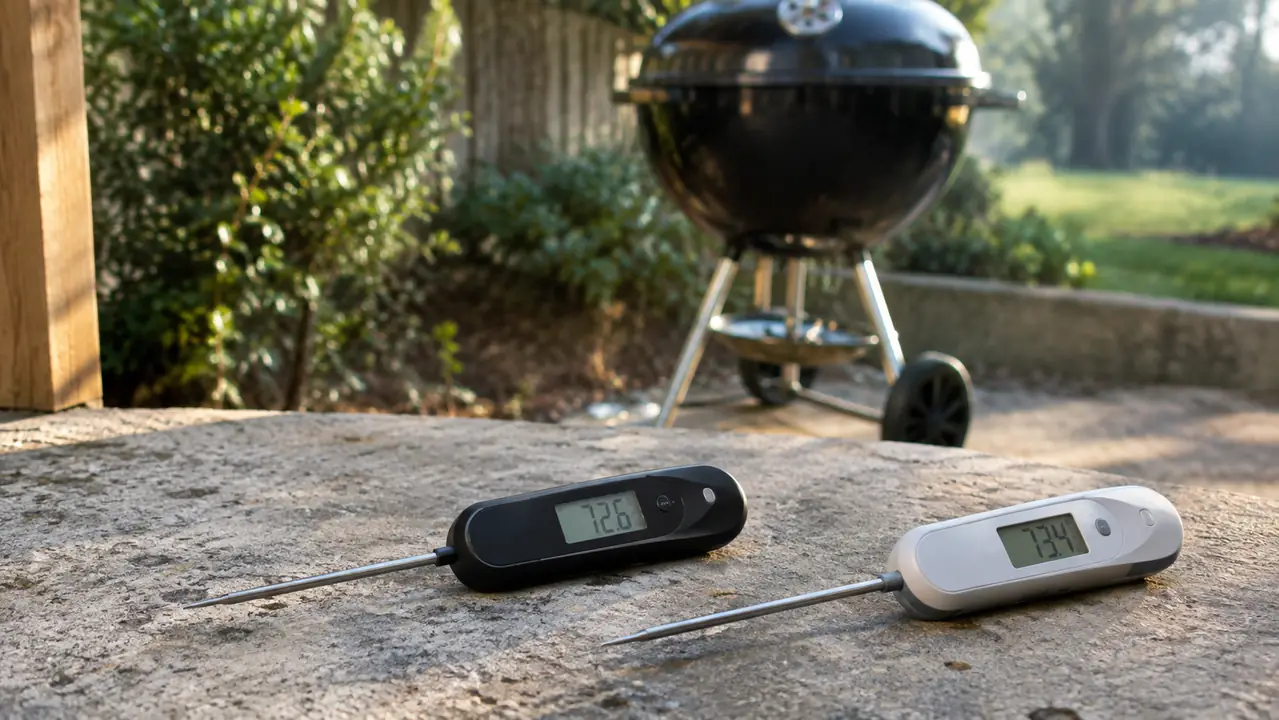
I've been cooking over fire for thirty years. For most of that time I used a cheap dial thermometer that was wrong half the time. The needle would stick, the glass would fog, and I'd end up guessing when the pork shoulder was done. Two years ago I finally got serious about temperature. I bought two digital thermometers to see if the expensive one was worth the money. This is the TempPro TempSwift, a budget unit that costs a fraction of what the pros use, and the ThermoWorks Thermapen ONE, the gold standard that serious cooks swear by. I've used both on my charcoal kettle, my three-burner gas grill, and my mid-size pellet smoker. I've cooked through a Michigan summer and a winter that hit minus ten. Here's what I found. I'm not a scientist, just a guy who cooks a lot.
Right off the bat, they're not in the same class on cost. The Thermapen ONE costs more than three times what the TempPro does. If you only grill a few times a month, that difference buys a lot of meat. But if you cook every weekend like I do, the gap in speed and accuracy starts to matter. The question is whether the Thermapen's advantages are worth the extra money for you. I'll break it down the way I'd explain it to my neighbor across the fence. I'll also note that I didn't test these in a lab. I used them the way you would at home, with all the mess and variables that come with it.
| TempPro TempSwift | ThermoWorks Thermapen ONE | |
|---|---|---|
| Cost | A fraction of the cost | Premium cost |
| Read speed | 3 seconds to settle | 1 second, almost instant |
| Accuracy | ±1.8°F, good for most cooking | ±0.5°F, lab-grade |
| Leave-in use | Wire probe stays in the meat | Handheld only, no wire |
| Warranty | 1 year | 5 years |
| Display | Backlit, rotates | Brighter, auto-rotates |
| Best for | Budget cooks who want a reliable probe | Serious cooks who need speed |
How I Tested Them
I ran both thermometers side by side for six months. That meant using them on the same cuts of meat, at the same time, on the same grill. I'd take a reading with the TempPro, then immediately with the Thermapen, and write down both numbers. I did this for brisket, pork shoulder, chicken thighs, and a few steaks. I also left the TempPro's probe in the meat during a long smoke while I used the Thermapen to spot-check other parts of the meat. I wanted to see if the budget probe could keep up with the expensive one when it mattered. I also took notes on how easy they were to read in low light, because I often cook after dark.
The thermometers lived on my patio, exposed to rain, sun, and a Michigan winter. I didn't baby them. I dropped the TempPro once on the concrete, and the Thermapen took a tumble off the grill shelf. I also used them in freezing temperatures while I was pulling a pork butt at 6 a.m. on New Year's Day. That's the kind of abuse these tools have to survive around here. The freeze test was the real proof, though.
The Long Smoke Test
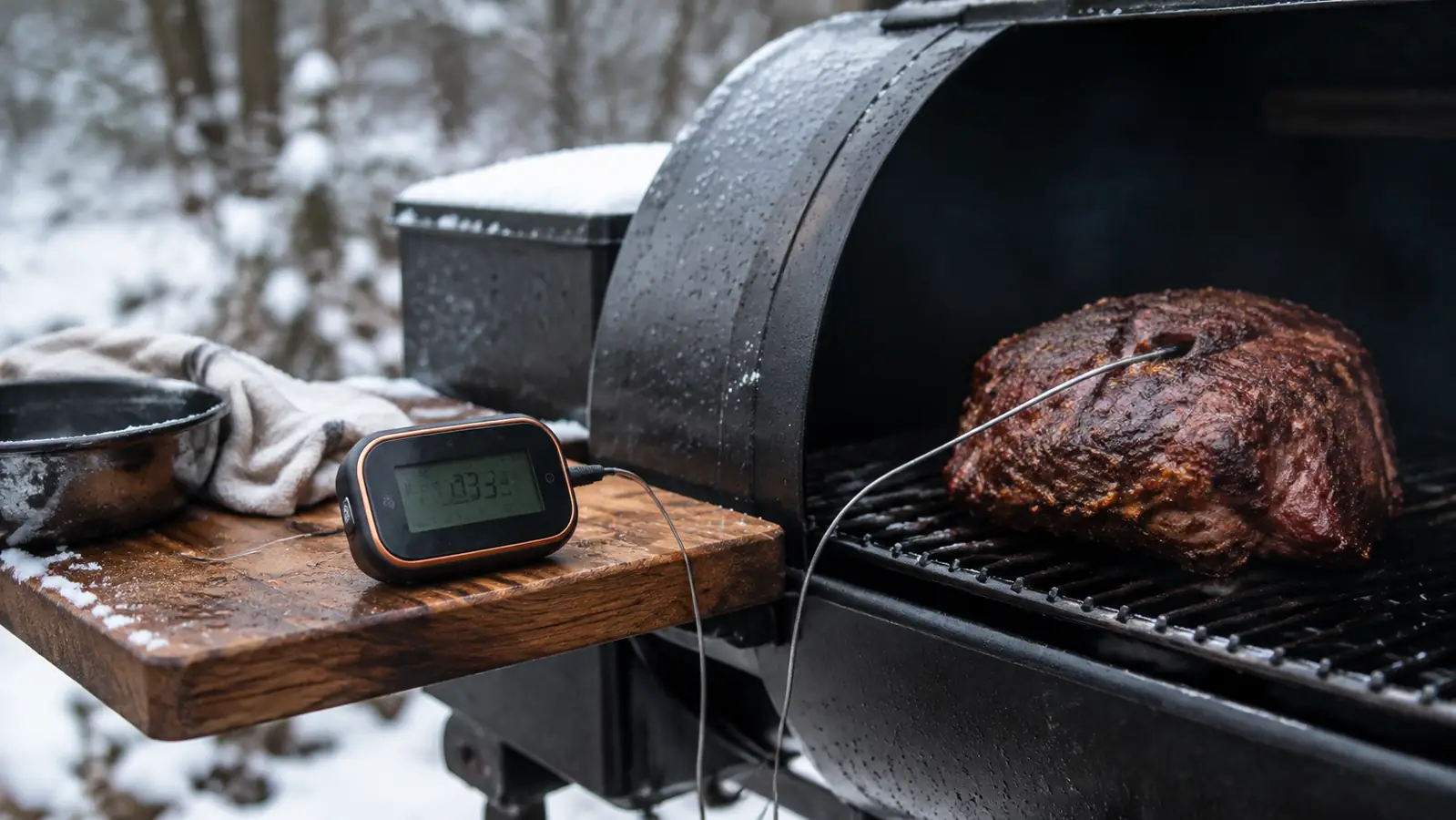
On a Saturday in February, I smoked a ten-pound pork shoulder on the pellet smoker. It was 12 degrees out, with a wind chill that made it feel like zero. I set up the TempPro with the wire probe in the pork, and I used the Thermapen to check the meat at different spots every hour. The TempPro's display sat on the smoker's shelf, and it held a steady reading all day. The Thermapen gave me the same numbers every time I poked the meat. By the end of the eight-hour cook, the pork hit 203 degrees and pulled apart like butter. Both thermometers agreed the whole way. That cook told me more than any spec sheet could. The wind was blowing hard that day, and I had to shield the display with my hand to read it.
The next weekend I did a reverse-seared ribeye on the gas grill. I used the TempPro to monitor the steak as it came up to 125, then seared it. The Thermapen confirmed the final temperature. The difference between the two was a single degree, which is within the TempPro's margin of error. For a home cook, that's nothing. The Thermapen's speed was nice when I was checking multiple steaks, but honestly, the TempPro got the job done. The sear came out perfect, by the way.
Where TempPro Wins
The biggest win for the TempPro is the cost. You can buy three of them for what one Thermapen costs, and that matters if you're on a budget or if you tend to lose things. I've had cheap thermometers walk off the patio before. With the TempPro, losing one isn't a disaster. The TempPro also has a wire probe, which the Thermapen does not. That wire lets you leave the probe in the meat while the display sits on the counter or hangs on the grill grate. I use it every time I smoke a brisket. I just poke the probe into the flat, run the wire out the vent, and set the display on the shelf. The Thermapen can't do that. It's a handheld instant-read, so you have to open the lid and poke the meat each time. That's a real difference in how you work. And the TempPro's probe is long enough to reach the center of a big roast without getting your hand close to the heat.
The TempPro also handles my stiff fingers better. The body is longer and the button is easy to press even with gloves on. The Thermapen's button is small and tucked under the probe hinge, and I've fumbled with it on cold mornings. The TempPro's display is also plenty bright, and it rotates automatically, so I don't have to bend over to read it. For a guy with arthritis, that's a bigger deal than you'd think. That's something I never thought about until I couldn't grip a small button on a cold morning.
Where Thermapen Wins
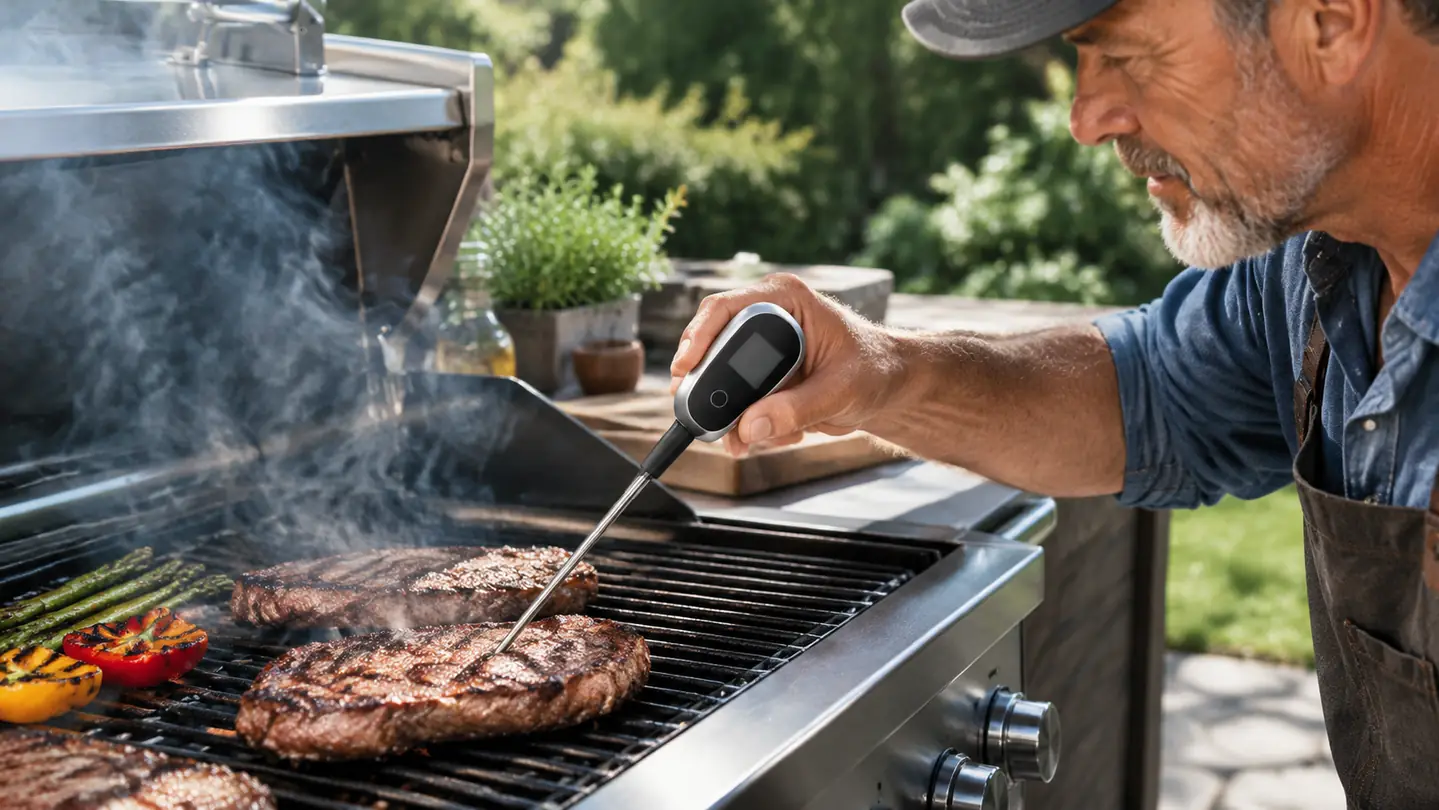
The Thermapen is faster and more accurate, and in cooking, that translates to better food. It reads in about one second, while the TempPro takes three or four seconds to settle. When you're checking a steak that's on a hot grill, that extra time means you're holding the lid open longer and losing heat. The Thermapen's accuracy is also better. It's rated at plus or minus 0.5 degrees Fahrenheit, while the TempPro is around 1.8 degrees. That difference matters when you're trying to hit a precise temperature for a prime rib or a cheesecake. I've seen the Thermapen agree with my temperature probes to the tenth of a degree, and the TempPro can be off by a couple degrees even after it settles. I also noticed the Thermapen's backlight is noticeably brighter, which helps on a cloudy day.
The Thermapen also feels like a precision instrument. The build quality is excellent. The probe folds into the body when you're done, so it's compact and the tip is protected. The TempPro is a plastic unit with a separate wire probe, and it feels cheaper in the hand. The Thermapen's display is brighter and easier to read in direct sunlight, which is where I do most of my cooking. And ThermoWorks backs it with a five-year warranty, which tells you they expect it to last. The TempPro comes with a one-year warranty, which is standard for the price. The Thermapen's hinge is smooth, and it locks open with a satisfying click.
The Everyday Details
Battery life is another place the TempPro surprises. It runs on a single AAA battery, and I've had it in there for four months without a change. The Thermapen also uses a AAA, but it seems to drain a little faster, probably because the display is brighter. The TempPro also has a magnet on the back, so I can stick it to the side of my gas grill. The Thermapen has a magnet too, but it's smaller and not as strong. Little things like that add up when you're reaching for the tool a dozen times a day. I keep a spare battery in the drawer next to the grill.
Cleaning is straightforward on both. The TempPro's probe is waterproof, so I can rinse it under the tap. The Thermapen's probe is also waterproof, but the whole unit is IP67 rated, meaning it can be submerged. I've never submerged either one, but it's nice to know the Thermapen can take a dunk. The TempPro's wire probe has a silicone sleeve that slides off for cleaning. Both are easy to wipe down. The Thermapen's foldable probe means there's no wire to get tangled, which is a plus when you're moving around the grill. The silicone sleeve on the TempPro's probe slides off easily, but it can get a little greasy if you don't rinse it after each use.
The TempPro's probe is a straight stick with a pointed tip. It's about five inches long, and the wire is three feet, which gives you plenty of reach. The Thermapen's probe folds into the body, so it's always protected when you throw it in a drawer. I keep the TempPro in its little rubber boot, which is fine. The Thermapen I just toss in a drawer. Both have their strengths. Both thermometers are compact enough to fit in a drawer, but the Thermapen folds up smaller.
The TempPro has an auto-off after about 10 minutes, which is a bit short if you're doing a long smoke. The Thermapen stays on for about an hour. I've had the TempPro shut off in the middle of a brisket, and I had to walk over and wake it up. That's a small annoyance, but it's worth knowing.
What's in the Box
The TempPro comes with the thermometer, a probe, a silicone boot for the probe, and a cleaning brush. The Thermapen comes with a protective case and a lanyard. Neither includes batteries, which is a bit annoying. The TempPro uses one AAA, and the Thermapen uses one AAA as well. I had to dig through my junk drawer for both.
Ready to save money without losing accuracy?
The TempPro TempSwift does everything most home cooks need, at a fraction of the cost of the big-name brand. Check today's price on Amazon and see if it's the right tool for your patio.
Amazon Check Today's Price on Amazon →Who Should Buy Which
If you cook a couple of times a week and want a reliable thermometer that won't break the bank, the TempPro is the sensible choice. It's accurate enough for anything you'll do at home, and the wire probe makes it perfect for long smokes. If you're the kind of cook who wants the fastest, most precise reading every time, and you're willing to pay for it, the Thermapen ONE is the one to get. It's the difference between a good tool and a great tool. For most people, the TempPro will do everything they need. For the ones who want the best, the Thermapen earns its keep. If you're just starting out, the TempPro is a great first thermometer. If you're a seasoned cook who wants the best, the Thermapen is worth the upgrade. If you're cooking for a crowd, the wire probe makes a big difference. That's the honest answer.
The Bottom Line
After six months of daily use, I can tell you this: the TempPro is a lot of thermometer for the money. It's accurate enough for anything I cook, and the wire probe is a feature the Thermapen doesn't offer. The Thermapen is faster, more precise, and built like a tank, but it costs a lot more. If you're on a budget, the TempPro will serve you well. If you want the best and you're willing to pay for it, the Thermapen won't disappoint. For most of the people I cook with, the TempPro is the smarter buy. I still reach for mine every weekend. I've been cooking long enough to know that you don't need the most expensive tool to make great food. You need a tool that works, that you trust, and that you'll actually use. The TempPro is that tool for me. I've cooked for my wife Marlene and the neighbors, and they've never complained about the food. And that's the honest truth.
Get the TempPro TempSwift
If you're ready to upgrade from a dial thermometer without spending a fortune, the TempPro TempSwift is the one to start with. See today's price on Amazon and read more honest reviews from home cooks like you.
Amazon See Today's Price on Amazon →