
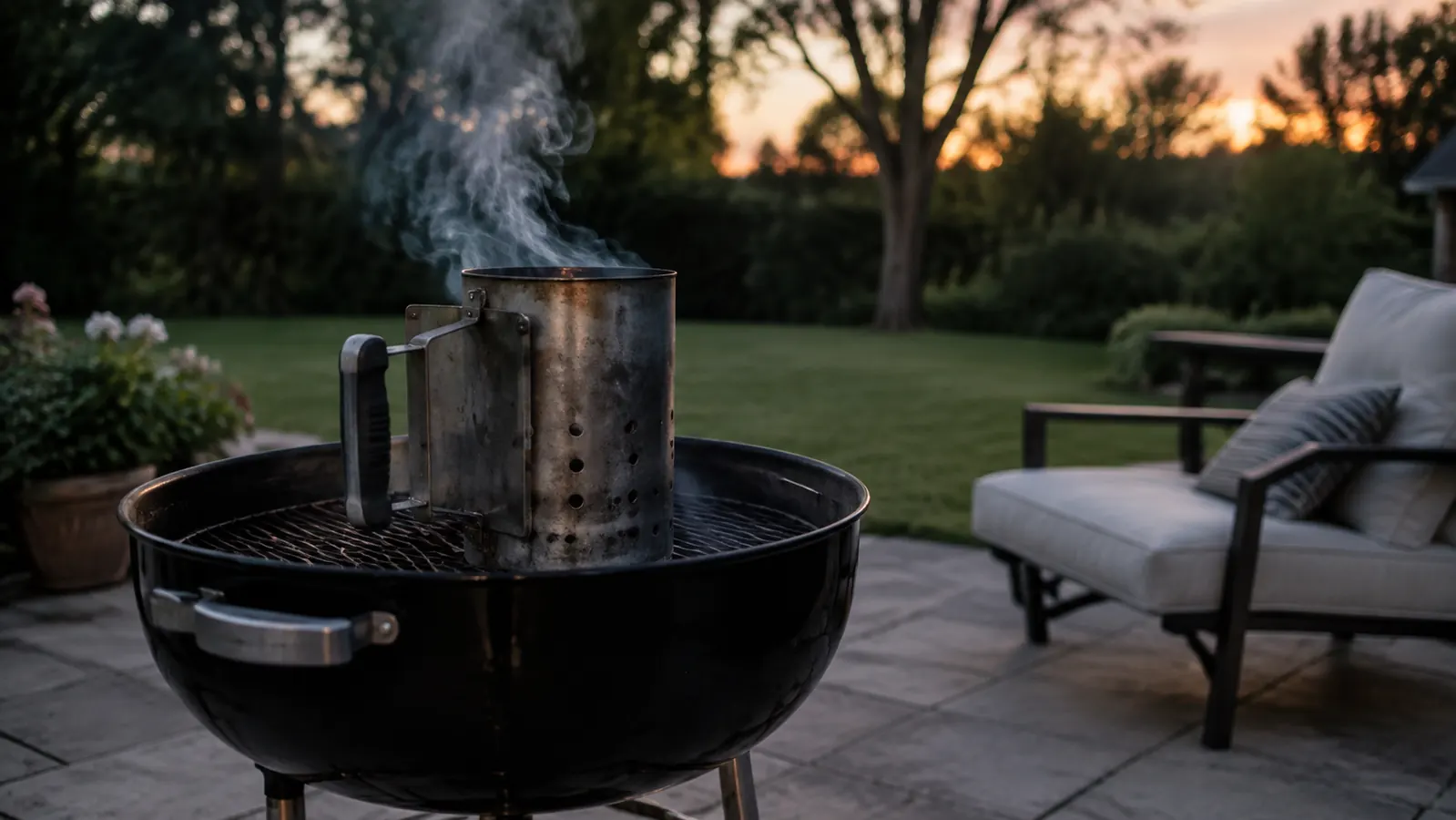
I spent more years than I care to count lighting charcoal with lighter fluid. It is what everybody did in the neighborhood where I grew up, and it worked well enough that I never questioned it. Then a buddy handed me a Weber chimney starter one summer and told me to try it once. I did, and I have not bought a bottle of fluid since. This is the comparison I wish somebody had handed me back then, written the way I would explain it over the fence: what each one does well, what each one does badly, and which one I would buy today.
Short answer: if you cook over charcoal more than a few times a month, the chimney starter wins. It gets coals ready faster in real minutes, it does not add anything to the air or the meat, and it costs nothing after the first purchase. Lighter fluid is not useless. It has two or three honest advantages, and I will name them below. But for the way I cook, on a concrete patio behind a 1960s ranch in Grand Rapids, the chimney starter is the better tool.
| Weber Chimney Starter | Lighter Fluid | |
|---|---|---|
| Time to first flame | About 30 to 45 seconds once the newspaper catches | Seconds after a match touches the soaked coals |
| Time to cooking-ready coals | Even gray ash over the top in about 20 minutes | 15 to 20 minutes, plus you wait for the fluid smell to fade |
| Taste of the food | Clean charcoal flavor, nothing added | A whiff of petroleum on the first batch if you overdo it |
| Effort to light | Crumple paper, fill the top, light the bottom | Squirt, wait a minute, strike a match |
| Cost over a season | One purchase, no refills | A new bottle every month or two |
| Cleanup and hands | Sooty hands from the metal, but nothing oily | Sticky bottle, slick hands, a smell that follows you inside |
| Wind and cold | The tube shelters the coals while they light | Wind can flare the flames and blow the fire out |
| Storage | The chimney starter takes up a shelf corner in the garage | A small bottle fits anywhere |
Where Weber Wins
The biggest difference shows up in the coals themselves. With fluid, you soak the pile, light it, and stand back while the flames roar. The fire is impressive, but it is also uneven. The coals that got the most fluid burn hot and fast, the ones that got less lag behind, and you spend the first part of the cook chasing hot spots. The chimney starter fixes that because it does not rely on an accelerant. You fill the top, crumple a little paper underneath, and light the paper. The heat rises through the column of charcoal, so every briquette lights from the bottom up at roughly the same rate. When the top coals are covered in gray ash, which for me is about twenty minutes, you have a uniform bed of coals. You dump them into the kettle, spread them level, and you are cooking. That even bed is the reason the Weber chimney starter has lived on my shelf for years.
Then there is the taste. I have cooked burgers over fluid-lit coals where nobody said a word, and I have also cooked the same burgers where the first batch tasted like a gas station. The difference is not subtle. When you use too much fluid, or you do not wait long enough for it to burn off, the meat picks it up. A chimney starter takes that variable off the table completely. The only thing reaching the food is heat from charcoal. I also like the cleanup. A fluid bottle gets sticky, the cap gets lost, and your hands carry the smell inside no matter how well you wash them. The chimney starter leaves soot on your palms, which is a different kind of dirt, but it washes off with plain soap and does not follow you around the house.
Living in Michigan, I also care about wind. A chimney starter keeps the coals sheltered while they light. I have started charcoal in a gusty yard with a chimney when a fluid-soaked pile would have flared and then died. That matters in November, when the snow is starting and you still want a burger off the kettle.

Where Lighter Fluid Wins
I said lighter fluid has honest advantages, and here they are. The first is speed to first flame. If you are in a hurry, a squirt of fluid and a match gets fire going in seconds, while a chimney starter needs you to find newspaper, crumple it, fill the top, and light the bottom. The chimney is not hard, but it is more steps. For a Tuesday night when you just want two burgers, fluid is the faster path to a lit fire. The second advantage is effort. There is no learning curve with fluid. You do not need to figure out how much paper to use or where to light it. You squirt, you wait a minute, you light it. A person who grills a few times a summer will get the same result every time.
The third advantage is storage. A bottle of fluid slides into a cabinet or a drawer, and it does not care about rain or snow. The chimney starter is a bulky piece of metal that needs a dry shelf or a hook. In my garage it takes up a corner, and in a small apartment or a shared garage that corner might be hard to spare. I also have to admit that fluid is familiar. If you grew up with it, like I did, it does not feel dangerous or complicated. It feels normal. That is a real advantage, because the best tool in the world does not help if you reach for the thing you already know.
There is one more thing worth saying in favor of fluid. It works in a pinch when you have no newspaper, no dry kindling, and no time. I keep a bottle in the garage for exactly that reason, even though I almost never use it. It is cheap insurance, and it takes up almost no room. When the power is out and the steaks are thawing, I would rather have the bottle and not need it than need it and not have it.
A Few Details Worth Knowing
First, a chimney starter is not magic. You still have to wait for the coals to ash over, and on a damp day that wait can stretch past twenty minutes. The difference is that the wait is predictable. You are not standing there wondering whether the fluid burned off or whether the coals are ready. Second, use dry newspaper. Damp paper is the only time a chimney has failed me. Tear it into loose sheets, crumple them into the bottom, and light them in two or three places.
Third, set the chimney on something that will not burn. I put mine on the concrete patio or on the grill grate, never on the deck boards. The bottom gets hot enough to scorch wood. Fourth, use a glove or a thick towel on the handle when you dump the coals. The handle stays cooler than the body, but it still gets warm after twenty minutes. Fifth, and this one surprises people, do not use lighter fluid with a chimney starter. There is no need. The paper does the job, and adding fluid just adds smell.
The Weber chimney starter holds a standard load of charcoal, which is enough for a full kettle and a crowd of six to ten. I fill the top with briquettes or lump charcoal, light the paper, and go inside to prep. Twenty minutes later I dump a bed of even coals into the kettle and start cooking. That is the whole routine, and it has not changed in years.

What About the Smell?
People ask about the smell of lighter fluid because they have been burned before. The smell is real, and it is the main reason I switched. Even when you let the fluid burn off, there is often a faint petroleum note hanging over the grill for the first few minutes. It does not always end up in the food, but it is in the air, and it changes the experience of cooking outside.
The chimney starter changes the whole picture. The only smell is paper smoke for the first minute, then clean charcoal smoke for the rest of the cook. That is what a backyard should smell like. If you have ever stood over a grill and wondered why the burgers taste a little off, this is usually the answer. The fix is not a different rub or a better sauce. It is simply how you light the coals.
Skip the Fumes, Get Even Coals
The Weber chimney starter is the one tool I would not give back. It lights evenly, it adds nothing to the flavor, and it will still be on the shelf next season. Check today's price and see for yourself.
Amazon Check Today's Price on Amazon →Who Should Buy Which
Buy the chimney starter if you cook over charcoal more than a handful of times a year. That is the simple rule I give neighbors. If you are already setting up a kettle, waiting twenty minutes for coals is not a new wait, and the payoff is better flavor and fewer hot spots. The Weber chimney starter also makes sense if you cook for company, because you can start a full load of coals while you prep, and it will be ready when the meat is. I use it with lump charcoal and with briquettes, and it works the same with both.
Buy lighter fluid if you grill rarely, if you have no dry place to store a chimney, or if you simply do not want another piece of equipment. There is nothing wrong with that. Use less than you think you need, wait for the flames to die down, and you will get decent results. I would not tell anyone to throw away a half-full bottle. I would only say this: when that bottle runs out, try a chimney for a month. You will know by the end of the month which one you reach for first.
If you are still deciding, think about how often you actually light the grill. A chimney starter earns its shelf space through repetition. The more you cook over charcoal, the more you notice the even coals and the clean taste. The less you cook, the less those things matter. I have owned both at the same time, and I still do. The bottle sits in the cabinet for emergencies. The chimney sits on the shelf and does the work.
The Bottom Line
If I had to pick one and only one, I would pick the Weber chimney starter. It is not because lighter fluid is evil or dangerous. It is because the chimney does the job with fewer variables. You get even coals, no chemical taste, and no bottles to buy. The trade is a little more setup and a little more storage. For someone who cooks outside most weeks of the year, that is a trade I would make every time.
Lighter fluid will still be in my garage, because there are days when it is the fastest way to a fire. But it is the backup, not the main tool. The main tool is the chimney starter, and I do not see that changing. If you are on the fence, buy the chimney first and keep the bottle as a spare. That is exactly how I have done it for years.
Make the Switch This Weekend
One purchase, no bottles, cleaner coals. If you cook outside most weeks, this is the tool that earns its place on the shelf. Check today's price and see for yourself.
Amazon Check Today's Price on Amazon →