

Most grill brush reviews read like the manufacturer wrote them. Mine is not going to be one of those. I bought the Weetiee brush in April of last year, ran it through a full Michigan season on three different grills, and I am here to tell you where it wears out and when to throw it away. The second part is the part nobody writes about.
Weetiee makes a bristle-free stainless brush with an 18 inch handle and a flat scraper edge on the back. The whole point is you skip the wire bristles that shed and end up stuck in your food, and use a looped stainless coil instead. It is a good idea. I used wire brushes for twenty five years, and a bristle turned up in a burger at my own table once. Once is enough. But a good idea on paper and a good tool on a hot grate are two different things, and the difference shows up around month seven.
The Quick Verdict
A good bristle-free brush with a scraper that rounds out after a season. Buy it for the coils, treat the scraper as a wear part, and you will not be disappointed.
Amazon Check Today's Price →The honest version: the scraper wears, the coils last
After a full year on three grills, the coil side is still cleaning and the scraper has gone dull. If you want a brush that never puts bristles in your food and rinses clean after every cook, this is it, with one honest caveat about the scraper edge.
Amazon Check Today's Price on Amazon →How I've Used It
Every grill brush gets judged on a hot grate, not in a showroom. I ran this one on all three of my grills over twelve months. The 22 inch charcoal kettle gets the hardest work, because I cook over lump charcoal and the grate sits right over the fire. The three burner propane grill is the weeknight machine, so it gets used two or three times a week and never gets a dramatic cleaning, just a scrape and a wipe. The pellet smoker is the one that tells you the most, because it runs low and slow and the grease builds up in layers that a brush has to cut through, not just push around.
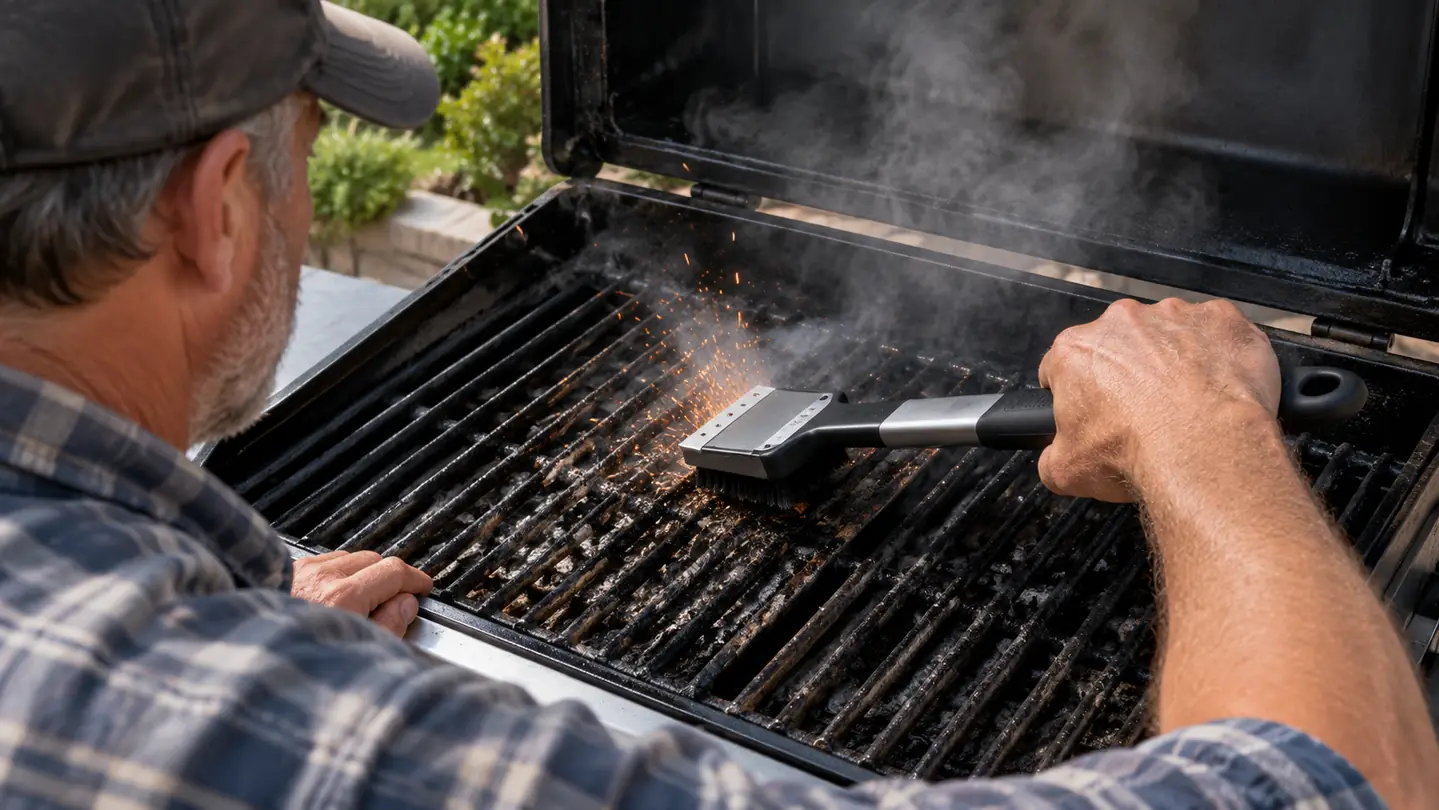
When the brush was new, the scraper edge took care of the kettle grate in about ninety seconds. I would light the charcoal, let it get good and hot, and then run the scraper across the bars while the fire was still going. That is the only way to clean a charcoal grate, in my opinion, hot and fast. The flat edge bites in and peels the carbon off in long strips. It worked that way for the first six months. I remember one Saturday in July, a full rack of ribs and a dozen burgers, and the grate came clean in one pass per bar.
The propane grill was where the brush did its easiest work. The grate is porcelain coated and the bars are closer together, so the coil side gets used more than the scraper. The coils are flat stainless ribbon, not wire, and they flex enough to get between the bars without catching. It takes longer than a wire brush, maybe twice as long, because you have to go back and forth instead of side to side. That is the trade-off you make for not having bristles in your food.
What Wears Out First
The honest answer, and the part nobody tells you, is the scraper edge wears down long before the coils do. By September, five months in, I could feel the edge getting round. It still worked, but it stopped peeling and started pushing. Carbon that used to come off in one pass needed three or four, and some of it needed a soak and a stiff wire pad afterward. I noticed it most on the kettle, because that grate gets the hardest treatment.
By December the scraper had lost most of its bite. I am not saying it was useless. It still knocked the big chunks off. But the reason you buy this brush over a cheaper one is the scraper, and once the edge rounds out, you are carrying around a very expensive coil brush. I checked the edge with my thumbnail the way I used to check a cutting tool in the shop, and it had a visible flat spot running the whole length. That is what a machinist means when he says a tool is dull. It does not cut, it rubs.
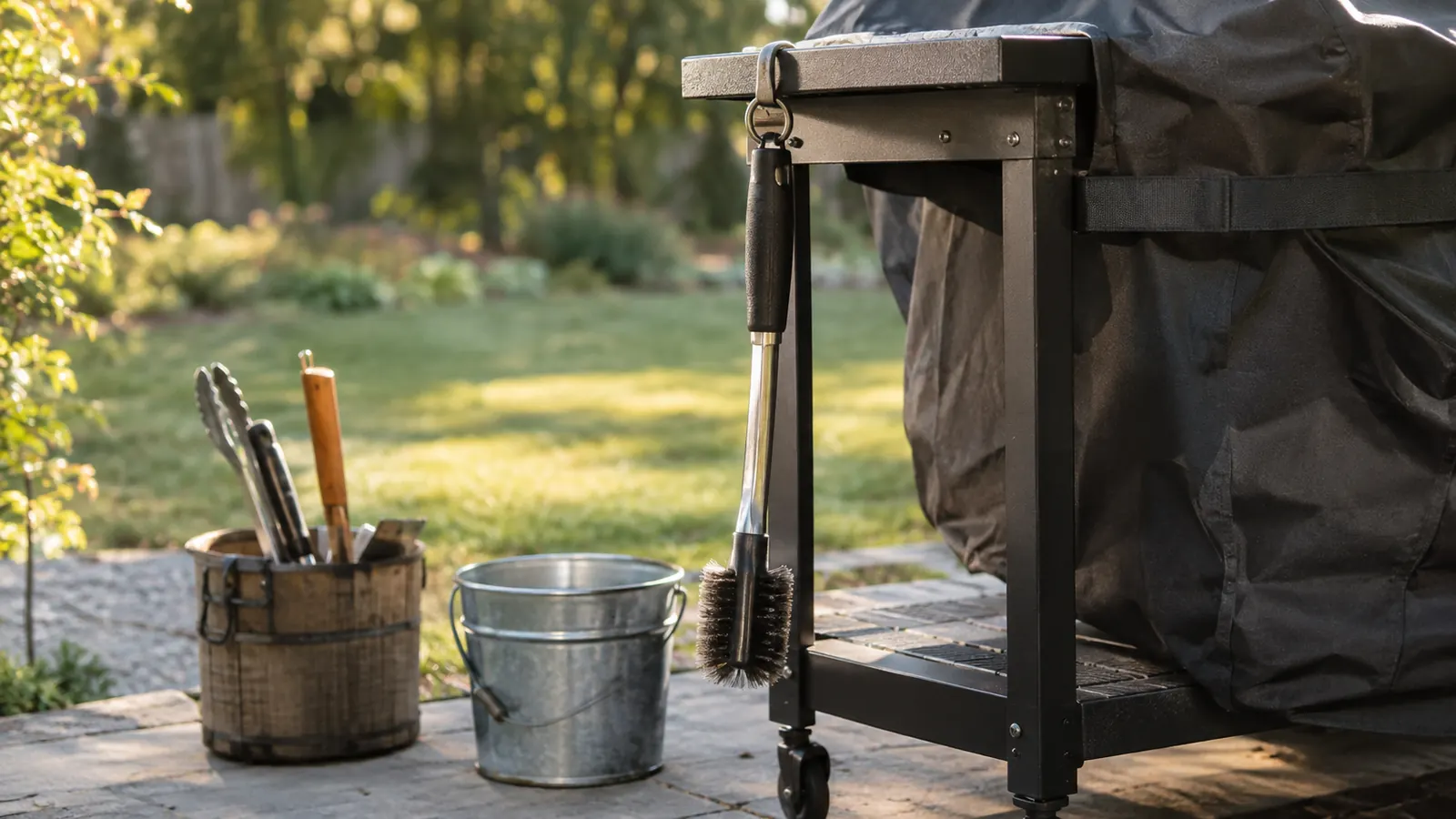
The coils held up better. After twelve months I cannot say the coils have worn out. They have stretched a little, and the ones at the ends have started to open up, but they still do their job. The stainless has not rusted, which surprised me, because it lives on a patio in Michigan and gets rained on more than it should. I store it hanging on a hook under the grill cover and it still comes out clean in the spring. That is more than I can say for the wire brush I had before it, which was a rust-colored mess by May.
There is one other thing that wears, and it is not the brush. It is the coating on the handle. The handle is covered in a soft grip material, and after a season of sun and frost it gets tacky, then sticky, then it starts to come off in flakes. By spring I was picking black bits off my hands after a long cook. It has not affected how the brush works, and the handle itself is solid underneath, but it is the first thing that will make you want a new one.
A wire brush is never clean. The Weetiee comes out of the rinse looking like a new brush.
The Handle and the Grip
This is where I have a personal stake, and I want to be fair about it. Thirty years of machine work left my fingers stiff, and in the cold months they do not close all the way. So handle length and grip matter to me more than they might to you. The Weetiee handle is 18 inches, which is plenty long to keep your hand out of the heat. I have never burned my knuckles with it, even on the kettle, and I have been burned by shorter brushes plenty of times.
The grip diameter is what I would call medium. It is not a skinny handle you have to squeeze, and it is not a fat one that fills your palm. For me, that is just about right. I can get a solid grip with two fingers and a thumb when the weather is cold, and I have not dropped it once in a year. A thicker handle would be easier on my hands but harder to hold for a long cleaning. I will take the trade.
The one thing I will note against it: the grip gets slick when your hands are greasy. You are cleaning a grill, so your hands are greasy. There is no texture to the grip material, no ridges, so a wet or oily hand slides a little. It has never slipped out of my hand, but I have caught it a couple of times. If your hands are smooth and dry, this will not matter to you at all. If you cook with oil the way I do, you will learn to wipe your hand on your apron before you grab it.
How It Cleans Up and How You Store It
The brush itself cleans up easier than it cleans the grill. After a cook I scrape the grate, then run the brush under the hose to knock the loose stuff off, then hang it to dry. That is the whole routine. Because the coils are flat stainless and the scraper is one solid edge, there is nowhere for gunk to hide. A wire brush, by contrast, has a thousand little crevices between the bristles, and those crevices hold grease that goes rancid and then you are wiping old grease onto a clean grate. The Weetiee does not have that problem.
I want to say that part clearly, because it is the strongest thing this brush has going for it. A wire brush is never clean. You rinse it and it looks clean, and then the next time you use it you see the brown streaks it is leaving behind. The Weetiee comes out of the rinse looking like a new brush. That is a real difference, not a marketing difference.
Storage matters and nobody mentions it. This brush is 18 inches long and does not fold. It hangs fine on a hook, and it stands up in a bucket, but it will not fit in a drawer or a small grill cart. I keep mine on a hook screwed into the side of the cart, and that has worked all year. If you have no place to hang an 18 inch tool, you will leave it on the grate and it will get rained on, and while the stainless itself will not rust, the handle coating will go bad faster. Plan for where it lives before you buy it.
The Honest Math on Replacement
So here is the honest math. The brush did its best work for about six months. After that, the scraper went from sharp to useful to mostly decorative over the next four or five. Twelve months in, I am still using the coil side and it still does the job, but I have to put more effort in. If I were a person who wants the grate really clean, I would have replaced it at the ten month mark. If you are fine with a reasonable clean, it will carry you to a year and change.
Compare that with a wire brush. A decent wire brush costs less and it works faster, but the bristles shed, they rust, and they stop cleaning the same way around the same time, usually by the end of a season. So the real difference is not cost over time. It is that the Weetiee does not put metal bristles in your food, and it cleans up after itself. For that you give up some speed and you accept that the scraper edge is a consumable part. Both of those are fair.
What I would tell you plainly: buy this brush expecting the scraper to be a one-season tool. Do not buy it expecting it to last forever, because it will not. If you treat the scraper as the part that wears, and you are willing to replace the whole brush when it does, then this is a good value. If you expected a stainless brush to outlive your grill, you will be disappointed, and I do not want you to be surprised by that a year from now. That is the honest review.
The Bristle-Free Case, Made Plain
I want to spend a minute on the bristle-free part, because it is the reason anyone buys this brush, and it is also where the marketing gets loud. The claim is simple: no wire bristles means no bristles in your food. That is true, and it is a real thing. I have known people who had to throw out a whole brisket because a bristle got embedded and they could not find it. I have had it happen to me once, and once changes how you look at wire brushes forever.
Here is what nobody tells you about the bristle-free case: the coiled stainless is not magic. It does the same job the bristles did, it just does it without leaving metal behind. But it is slower, and it does not get into the corners of a grate the way bristles do. On a kettle grate with round bars, the coils wrap around nicely. On a flat rod grate, you have to work a little harder to get the top and the sides of each bar. It is a trade, and it is a fair trade for most people.
The safety angle is worth more than the convenience. I would rather spend an extra two minutes per cook than wonder, every time I serve pork to a house full of company, whether I missed a bristle. That is the whole case for this brush in one sentence. If that sentence lands for you, the slower clean will not bother you. If it does not land, you will be annoyed every single time you use it, and you should buy a wire brush instead. Both are honest choices.
What I Liked
- No wire bristles to shed into food
- Flat stainless coils rinse completely clean, no rancid grease hiding in crevices
- 18 inch handle keeps your hand well out of the heat
- Coils outlasted the scraper and are still going at twelve months
- Stainless did not rust through a Michigan winter
Where It Falls Short
- Scraper edge rounds out after five or six months
- Slower than a wire brush, needs back-and-forth passes
- Handle coating gets tacky and flakes after a season
- 18 inches does not fold, needs a hook or a bucket to store
Who This Is For
This brush is for the home cook who wants a clean grate and does not want to think about bristles in the food. If you cook most weeks, if you have a kettle or a gas grill, if you are tired of the rust pile that was last year's wire brush, this is a solid tool. It is especially good for anyone who cleans the grill the way I do, hot and fast, because that is where the scraper shines, at least for the first half of its life.
It is also for the person who stores their brush properly. If you have a hook or a spot to hang an 18 inch tool, and you do not mind rinsing it after each cook, you will get a full season out of it and a good chunk of the next one. I would buy it again for the coil side alone, because a brush that cleans itself is worth the slower scrape.
And it is for the cook who has had the bristle scare. If you have ever pulled a wire bristle out of a steak, or watched someone else do it, you will not want to go back to wire. I am not going to tell you this brush is perfect, because it is not. The scraper wears out and the handle coating gets tacky. But I have never once wondered whether I left metal in the food, and that peace of mind is the whole reason I keep using it on the kettle.
Who Should Skip It
Skip it if you are the kind of cook who wants the grate spotless in one pass every single time. A wire brush is faster, and if you inspect your grate before every cook and you have never found a bristle, then the risk may not be worth the slower clean to you. I am not going to tell you that the Weetiee cleans as fast as a wire brush, because it does not, and anyone who says it does is selling something.
Skip it if you have nowhere to store it, because leaving an 18 inch brush lying on the grate will wear out the handle coating fast. And skip it if you expect stainless to mean maintenance free. The metal is fine. The scraper is a wear part. If you are not willing to replace a brush every season or so, you are the kind of person who should buy a cheap brush and throw it away every spring, and that is a perfectly honest way to live.
One more, and this is the one I almost did not say: skip it if you do not mind bristles in your food. I know that sounds like a joke, but there are plenty of people who have used wire brushes for decades, never found a bristle, and are not worried about it. If that is you, this brush is a solution to a problem you do not have. Save your money. The people this brush is for are the ones who have already had the scare or who cook for company and do not want to gamble.
If the bristle scare is real for you, this is the brush
Twelve months in, I still use it every week on all three grills. The scraper is a wear part, and now you know it before you buy. That is the honest version of this review.
Amazon Check Today's Price on Amazon →