

The first time I pulled a wire bristle out of my food, I was thirty years into the trade and figured I had seen every way metal can surprise you. It came off a cheap grill brush I had owned for one season. The bristle was stuck in a burger patty, pointing up like a tiny antenna, and my son-in-law chewed on it for a full second before his teeth found it. Nothing bad happened that night. I did not sleep great anyway. The next morning I went looking for a different way to clean my grates.
That was two years ago, in the summer of 2024. I have cleaned my grates after every cook since, and I have not touched a wire brush since that night. The tool that replaced it is the Weetiee bristle-free grill brush, and the method is simple enough to write down. It works on all three of my grills: the 22-inch charcoal kettle I have owned for eleven years, the three-burner propane grill I use for weeknights, and the pellet smoker I bought used four years ago.
I want to be clear about the stakes before we get into it. A loose wire bristle can end up in your mouth, your throat, or worse. The cases are rare, but they are real. When you feed a crowd from a grill, which I do most weekends, you do not get to decide who finds the bristle. You only get to decide whether it is in the food. That decision is easy once you have seen one pointing out of a burger patty.
Skip the Wire Brush. Clean Every Grate With a Bristle-Free Scraper
The Weetiee bristle-free grill brush scrapes char off with a stainless edge, no loose metal fibers to end up in the food you feed people. I have used one for two years and it is the only grill cleaner I reach for now.
Amazon Check Today's Price on Amazon →Step 1: Get the grate hot
Before you start, understand that you are scraping, not scrubbing. A wire brush grinds at the grate. The Weetiee uses a flat stainless edge to peel the char off in one pass, and there are no bristles of any kind on it, which is the whole point. Heat is the whole game. Burnt-on food is mostly carbon and protein, and carbon lets go when it gets hot. The hotter the grate, the less scraping you have to do. My rule is simple: never scrape a cold grate. I have seen people hose a hot grate down and then scrub it cold. That is how you warp a grate and rust the paint off the frame.
I give the gas grill fifteen minutes with all three burners on high and the lid closed. The thermometer settles around 550 degrees, and at that temperature the residue turns to ash instead of tar. The kettle gets a full chimney of lump charcoal, dumped and spread, and I leave the lid on for ten minutes. The smoker I run at 275 for a half hour before a cook, which does not get the grates as hot, so I plan on a little more elbow work there. The first season with the Weetiee brush I was impatient and scraped a warm grate, not a hot one. It worked, but I had to go over the same bar three times and my shoulder felt it for two days. When the grate is properly hot, one pass does it.
Why the wire brush had to go: I used one for years because it was cheap and it worked, until the day the bristle showed up in the food. After that I could not unsee it. Every time I used the wire brush I would find a bristle or two in the sink or on the grates afterward, and I would wonder how many I had missed. It is a tool that slowly destroys the thing it is supposed to clean.
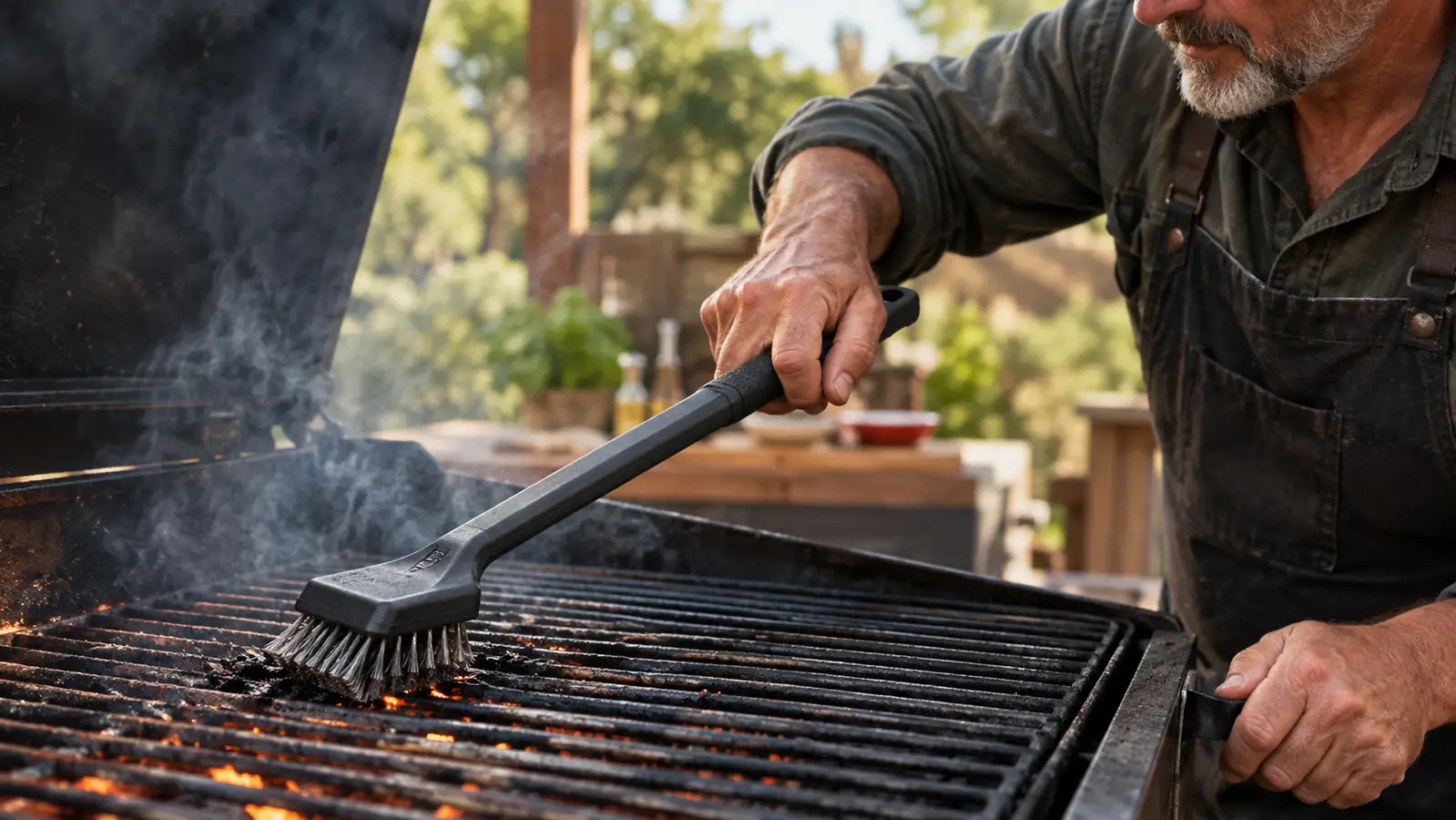
Step 2: Scrape while it is hot
This is where the Weetiee earns its place. The scraper edge is a flat stainless blade, and it takes the char off in ribbons instead of scratching at it. The 18-inch handle means I do not have to hover over the fire with my forearms singed, and the length gives me leverage without a lot of muscle.
Technique matters more than force. I hold the brush at a shallow angle, maybe twenty degrees, and pull it toward me in long strokes along the bars. One pass each way, then a quick side-to-side wiggle where the bars meet the frame. My hands are not what they were after thirty years of machine work, and this does not ask much of them. The grip is comfortable enough that I can work one-handed when I need to, which matters on a cold January afternoon.
I learned the hard way not to bear down. Pressing hard on a hot grate flexes the bars and makes the job slower, not faster. A light touch with a sharp edge beats a heavy hand with a dull one. That is true for a scraper and it was true for every cutting tool I ran in the shop. Let the heat and the edge do the work, and your forearm stays fresh for the next thing.
Step 3: Work the edges and corners
The wire brush always missed the corners. The head was round, so the square corners of the grate frame and the ends of the bars never got touched. After a few cooks, a crust built up there and I would have to get in with a putty knife, which is a clumsy way to work around hot metal.
The Weetiee reaches where the round brush could not. I work the scraper edge into the frame corners first, then along the ends of each bar, then the middle. It adds ninety seconds to the job and keeps the whole grate even. A grate with clean edges heats more evenly because there is no thick crust acting as insulation, and even heat is what you want when you are cooking for eight people. It also means the food does not stick where the crust used to be, which is usually right in the middle of the grate where you set the steaks.
On the kettle especially, the crust at the edge used to flake off into the coals and smoke up the next cook. I remember one cook in July 2023 where the smoke was bad enough that Marlene came out to check on me. The crust was burning on the coals and putting a bitter taste on everything. Now the corners come clean with the same brush, and the smoke is gone. That one change made the kettle easier to use than the gas grill, which surprised me.
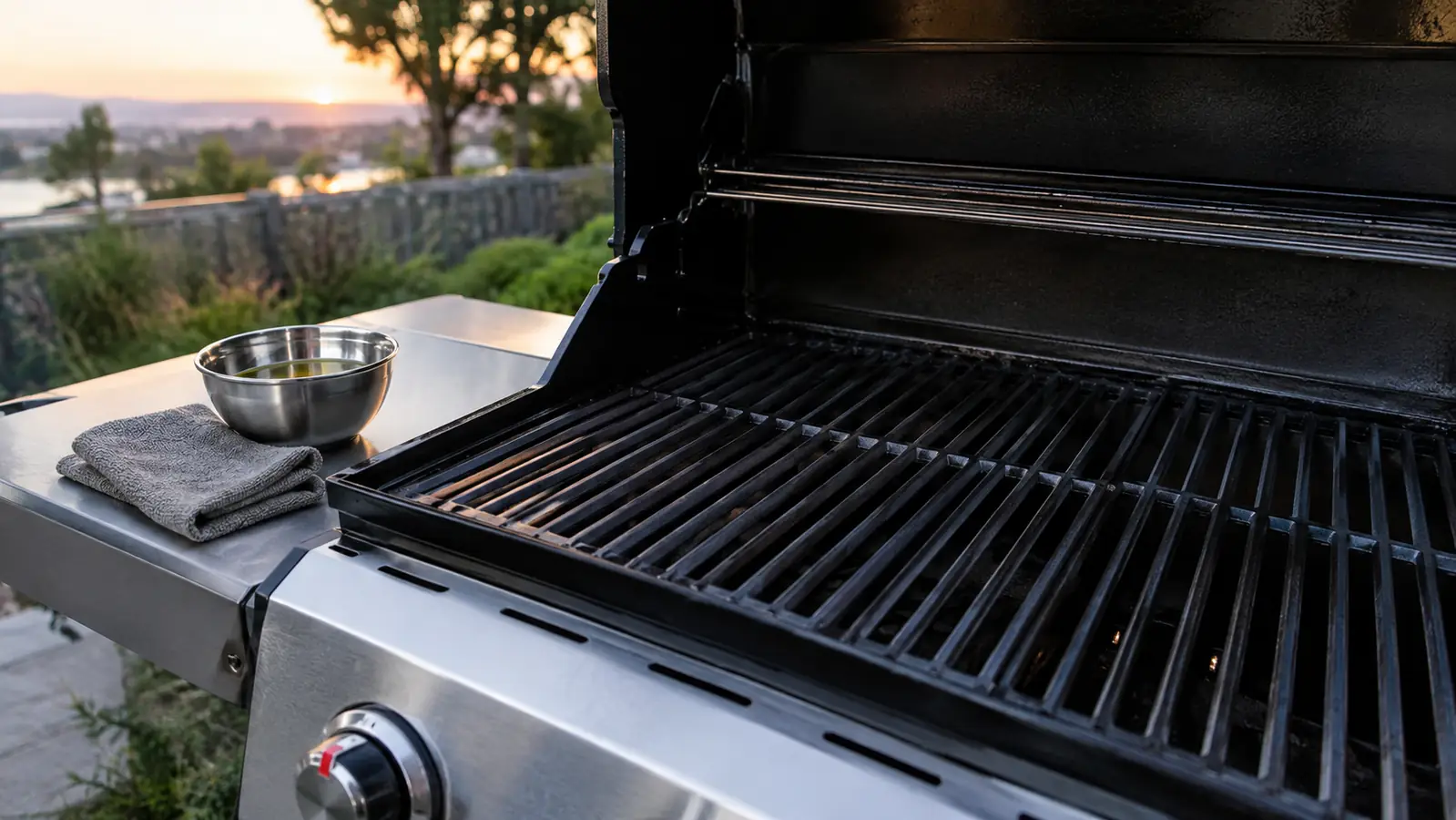
Step 4: Wipe down and oil
Scraping gets the big stuff. The thin film of grease that stays behind needs a wipe. I take a folded paper towel, hold it with a pair of tongs, and run it along each bar while the grate is still warm. It takes about a minute and it makes the next step work properly.
Then a light coat of oil. I use a rag dipped in canola and rub it over the bars, top and bottom. This does two things: it keeps the grate from rusting between cooks, and it seasons the metal so food releases instead of sticking. My kettle grate has had this treatment for eleven seasons and it still looks like it did when I bought it. That is not a small thing for a grate that sits out in a Michigan winter.
Some people swear by a cut onion for this step, and it works. The onion leaves a thin layer that is fine on food, and it smells good while you are at it. I use the oil rag most of the time because it is one less thing to dirty, but the onion is not wrong. Whatever you use, do not skip this step. If you skip the oil entirely, the grate will flash-rust by morning, especially in the humid months. I found that out my second season with the kettle. A grate with a film of rust is rough, food sticks to it, and you end up scrubbing harder the next time.
Step 5: Season and maintain
The last step is about the brush, not the grate. After I finish, I rinse the Weetiee under the hose to knock off the char dust and shake it dry, then I store it in the garage on a shelf by the door. I keep the head off the concrete so it airs out. In the winter months I wear a light glove on my left hand and work the brush with my right. The handle stays warm enough to grip, which is more than I can say for a bare metal scraper.
The grate itself gets the same respect. I leave it on the grill with the lid open until it cools, then close the lid. The oil I put on in step four does its work overnight. Come spring, the grates are clean and ready for the first cook of the season. I have done this every fall for years now, and I have not had to deep-clean a grate once.
A bristle-free brush lasts longer than a wire brush because there are no bristles to splay and shed. I am on my second bristle-free brush in two years, and the first one only retired because the handle cracked when I dropped it on the concrete in a January freeze. The head was still fine, and the second one has been going strong ever since. That is a fair run for a tool that gets used after every single cook.
What Else Helps
The brush does the daily work. For the rare bits that resist even a hot grate, I keep a flat steel scraper in the drawer. It is a plain bar with a handle, no bristles, and it takes off anything the brush leaves behind. I use it maybe twice a season, usually on the smoker grates after a long brisket cook where the drippings caramelized hard.
A ball of aluminum foil also works in a pinch. Crumple it into a fist-sized wad, grab it with tongs, and scrub the hot bars. The foil conforms to the grate and pulls off the film. It is not as good as the brush, but it is better than nothing when you are at a friend's house with no tools, and it is a good thing to know when you are camping.
Two things I tried and would not recommend: oven cleaner and a pressure washer. Oven cleaner leaves a residue that you do not want anywhere near food, and you will spend the next three cooks burning it off. The pressure washer works on the grates but it does nothing for the rest of the grill, and you get soaked doing it. Heat, a scraper, and a few minutes. That is the whole system.
The honest trade-off: a bristle-free brush is a better-made tool than a wire brush, and it shows. A wire brush that sheds bristles into your food is no bargain at all. The bristle-free brush does not wear out the same way, so it lasts. It is the only kind of grill cleaner I have bought in two years, and that says enough about its value.
Two years, three grills, and I have not found a single wire bristle in my food since I switched.
Retire the Wire Brush. Clean Grates the Safe Way
If you have a wire brush in the garage, retire it today. The Weetiee bristle-free brush does the same job without putting loose metal fibers into the food you feed your family.
Amazon Check Today's Price on Amazon →